Golfers first held the club with all ten fingers, both hands side by side on a hickory shaft wrapped in leather. That grip let the hands work against each other, so players began overlapping the little finger of the trailing hand over the leading hand instead, a method now known as the Vardon grip after Harry Vardon, though it is usually credited to the Scottish amateur Johnny Laidlay.
Nobody sat down and decided this all at once. The grip was worked out slowly, by players who noticed what held up in a wind, in wet weather and over a long round. Here is what we can say about it with confidence, and where the story goes quiet.
A club made to be held
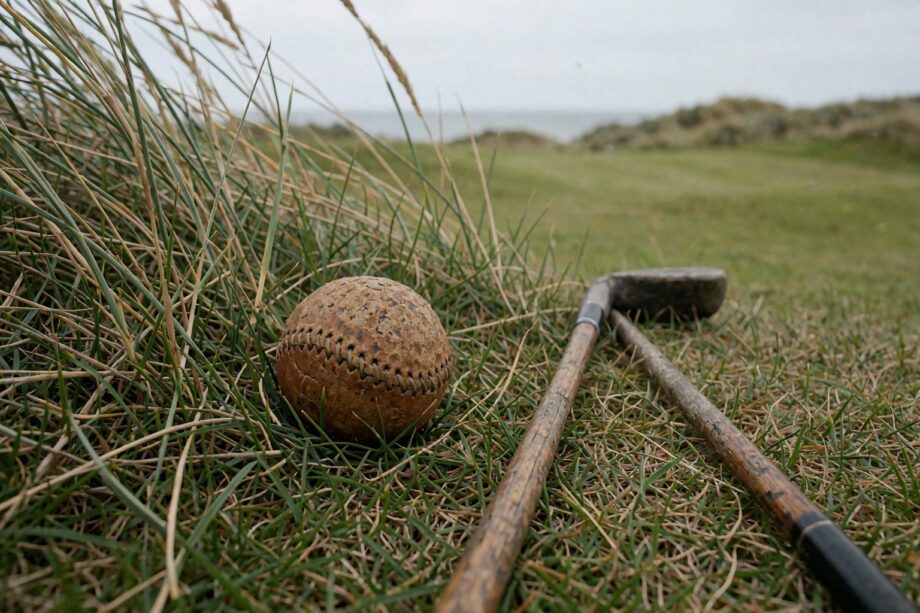
Start with the object itself. For a large part of the game’s recorded history, clubs were made by hand from wood, with a head spliced to a long, slender shaft. Through the nineteenth century, hickory became the shaft wood that players and makers came to prefer. It is tough and it flexes, then returns to shape, and much of it was brought in from North America. Ash and other woods had been used before it, but hickory earned its place because it could take the shock of a strike without giving up.
A bare wooden shaft is not much to hold on to, though, especially in the damp air of a links. So the top of the club was wrapped. Makers bound leather around the upper part of the shaft, spiralling it down from the top and securing it at the bottom, and a layer of material such as cord or felt was often placed underneath to build up the thickness. That hidden layer is known as underlisting, and it is one of those small workshop terms that tells you how much care went into something most players never gave a thought to.
The result was a grip you could feel. Leather went slightly tacky in the hand, it took on the mark of the player who used it, and it wore in a way that a good club-maker could read. If you have ever picked up an old wooden club and noticed how thin and firm the handle feels compared with a modern one, that is the hickory and the wrap doing what they were made to do.
What is the overlapping (Vardon) grip in golf?
How the hands sat on that leather is the more interesting question. The way most people first pick up any long-handled tool is to put both hands on it, palms facing each other, fingers all round the handle, one hand touching the other. Golfers held the club this way for a long time, and you still see beginners do it. It is often called the ten-finger grip, or the baseball grip, because all ten fingers are on the handle.
It is a perfectly natural way to hold a club, and for many players in the game’s early years, it did the job. It also has a weakness, and anyone who has played will recognise it. With the hands separate, they can work against each other. One hand can take over and turn the clubface. The wrists can act independently of one another. Hitting the ball straight becomes a matter of persuading two hands to behave as one.
The fix, when it came, was small and rather clever. Rather than keep the hands apart, players began to bring them together by letting one hand sit over or between the fingers of the other. That is the idea behind the overlapping grip. The little finger of the trailing hand rests on top of the gap between the first two fingers of the leading hand, or nestles between them. The hands become a single unit around the club, and the little finger of one hand does something useful instead of just hanging on.
Who invented the golf grip?
This is where Harry Vardon comes in, and where a little care is needed. Vardon, born in Jersey in 1870, was the dominant golfer of his era. He won the Open Championship six times, a record that still stands, with victories in 1896, 1898, 1899, 1903, 1911 and 1914. He also won the US Open in 1900. Because of that record, and because he was so widely watched and copied, the overlapping grip became known as the Vardon grip, and it still is.
Here is the part that often gets lost. Vardon did not invent it. The overlapping grip is usually credited to another player, the Scot Johnny Laidlay, a leading amateur of the late nineteenth century who used it while winning the Amateur Championship. What Vardon did was adopt it, play superbly with it and, in doing so, show the whole golfing world what it could do. He set it out in his book The Complete Golfer, published in 1905, which helped spread the method well beyond the people who had seen him play.
So if you want to be exact, the accurate way to say it is that Vardon popularised the grip rather than invented it. We think that is worth saying plainly, because the tidy version of the story is a better tale but not a truer one. Where exactly the first overlapping grip was tried, and by whom, is harder to pin down than the legend suggests, and we would rather leave that gap open than fill it with something we cannot support.
What can be said is that the change stuck. Within a generation, the overlapping grip was the standard teaching for good players, and it has stayed common ever since. Many golfers, particularly those with smaller hands or less strength, later took to a close cousin, the interlocking grip, in which the little finger and the first finger of the two hands hook together. Jack Nicklaus is among the great players who used that version. The principle is the same: get the two hands working as one.
What changed when the shaft did
The story of the grip cannot be separated from the story of the club. Hickory shafts and leather wraps belong together, and they belonged to an era when the club was as much a piece of craft as a piece of sports equipment. The move to steel shafts changed things. Steel was permitted by the governing bodies in the 1920s, the USGA approving it in 1924 and the R&A following in 1929, and it brought more consistency from one club to the next. Grips changed with it, moving over time towards materials that were easier to make in quantity and easier to keep in good condition.
None of that made the old way wrong. It made it a different kind of thing. A hickory shaft with its wrapped leather asks you to feel the club a little more, because it gives you less to lean on. It is one reason players who still swing old clubs talk about them with such affection.
Why the hold still matters
We find something quietly satisfying in this piece of golf history, because it is a story about small things. There was no grand invention behind the grip, no single moment of genius. There was a slow accumulation of players noticing that hands work better together than apart, and one champion who played well enough for everyone else to pay attention.
It is also a good reminder that the game is still, at its root, about a person and a stick. Change the grip by a fraction and the ball goes somewhere else. Every golfer who has stood on a tee and fiddled with their hands before the swing is taking part in a conversation that began a very long time ago, on ground that looked nothing like a modern course.
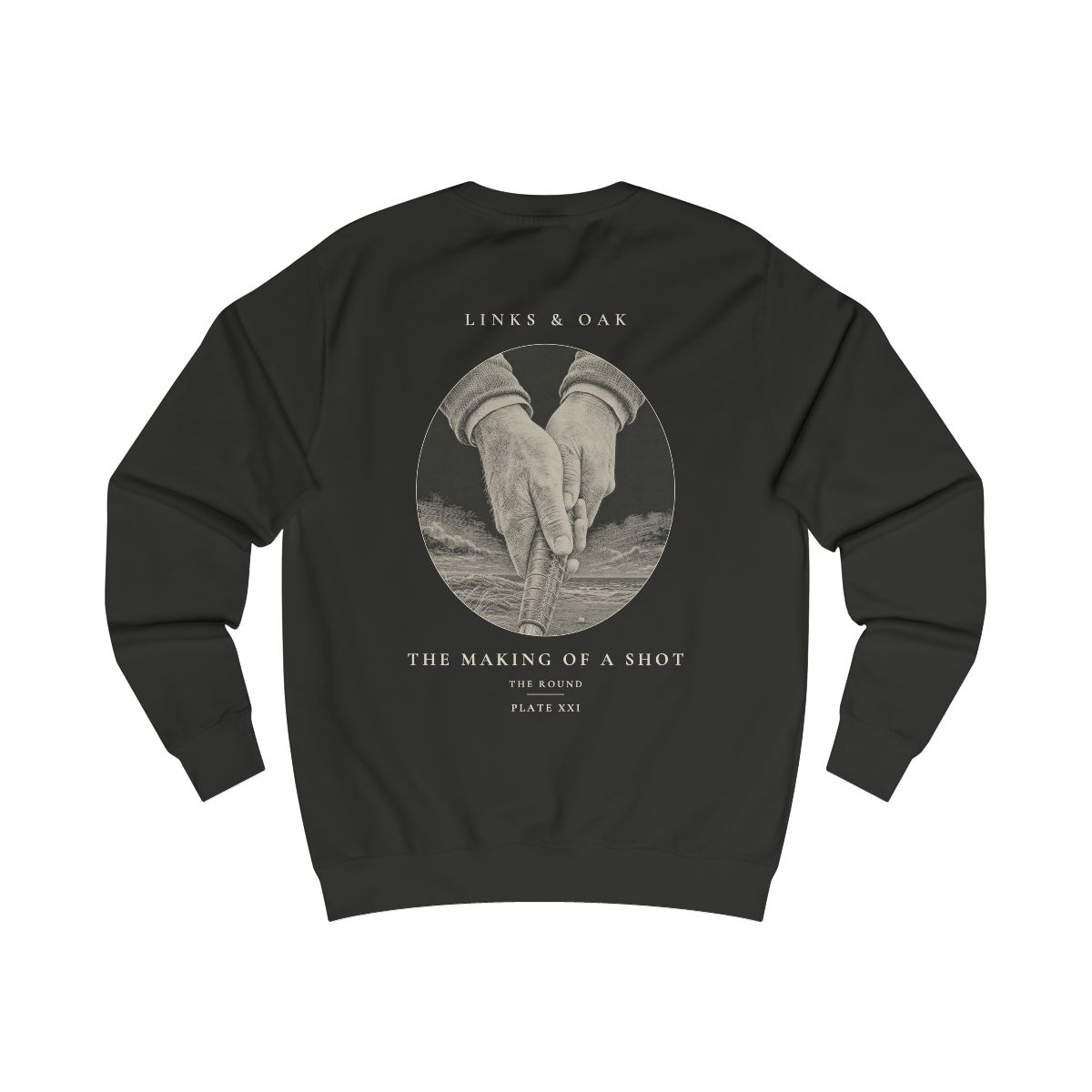
That is the moment we had in mind with the plate called The Making of a Shot. It is our own digital artwork in the engraving style, not an antique or a hand-engraved original, and it does not show any real named course. What it does show is the instant before the swing, when the hold, the stance and the intent all come together and the shot has not yet been made. If you love the old game and the way it was learned, take a look at it below.
See it in the collection: The The Making of a Shot design