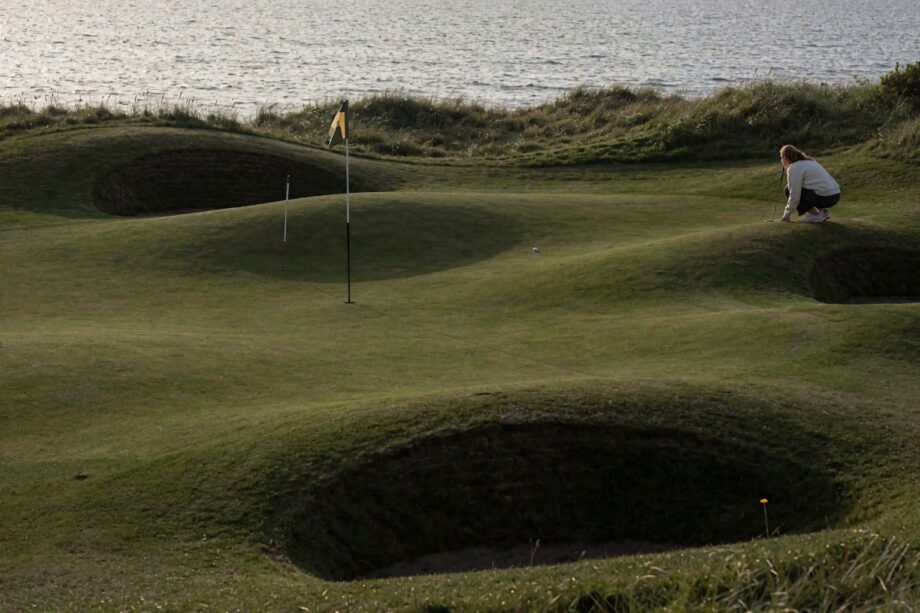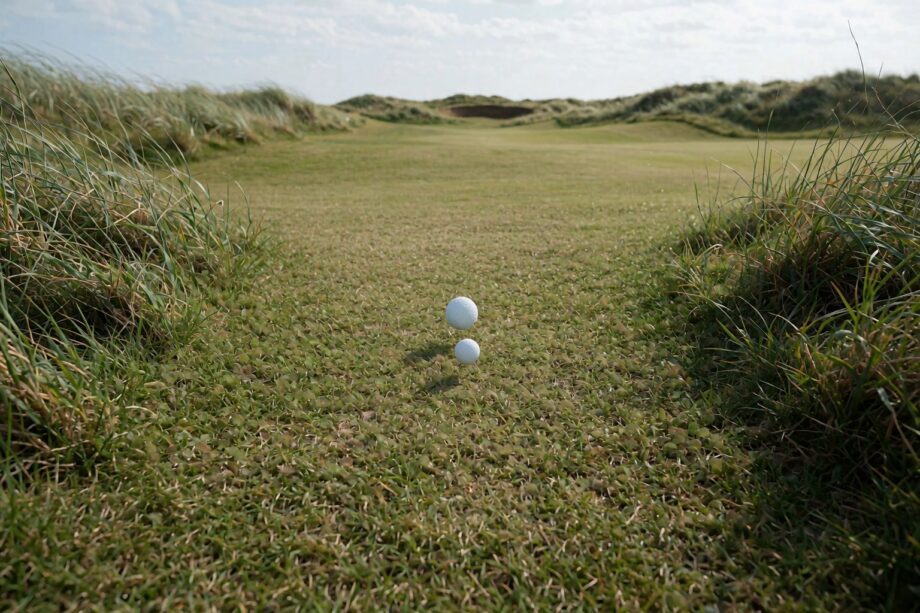

Waiting your turn in golf is called etiquette, and for centuries it was never written into the rules at all. The oldest surviving rules, drawn up in 1744 for the Gentlemen Golfers of Edinburgh, say nothing about pace of play; the courtesy of standing still while someone plays, and knowing whose turn came next, was left to custom until the Rules of Golf later gave etiquette its own section, and a 2019 rewrite finally put a number on it, 40 seconds a stroke.
The plate this story belongs to shows exactly that: the quiet, slightly comic discipline of standing still while somebody else plays. It is digital engraving-style artwork, made by us, and it does not show a real named course or a real historical moment. What it does show is a scene every golfer knows. So here is the real history behind it, with the gaps left as gaps.
A game that once had to wait for permission
The earliest written references to golf in Scotland are not flattering. In 1457 the Scottish Parliament, under James II, passed an act that told the people that football and golf should be “utterly cryit doun” (cried down, meaning forbidden). The reason was practical rather than moral. Men were expected to practise archery for the defence of the realm, and a game that pulled them away from the butts was a nuisance to the Crown. Later acts in the same spirit followed, in 1471 and 1491.
The ban did not work, which is a very golfing outcome. By 1502 the tide had turned so far that the royal accounts record James IV buying golf clubs. From that point the game belonged, in one form or another, to king and commoner alike, on the links land along the Scottish coast.
None of this tells us how those early players behaved on the course. There is no surviving rulebook from the fifteenth century, and anyone who claims to know the etiquette of those first golfers is guessing. What we can say is that the game was played over shared open ground, with walkers, animals and other players all around, so a habit of giving each other room must have been useful from the start. That is an inference, not a record, and I would rather label it as one.
When were the first rules of golf written?
The oldest surviving set of written rules of golf dates from 1744. They were drawn up for the Gentlemen Golfers of Edinburgh, who later became the Honourable Company of Edinburgh Golfers, and they were made for a competition over Leith Links, played for a silver club. There were thirteen articles.
Read them today and two things stand out. First, they are short and blunt. They deal with where you tee up, what to do when your ball is lost or stopped by a person, a horse or a dog (you play it from where it lies), and how to behave around your opponent’s ball when you are putting. One article says you must not mark your line to the hole with your club or anything else. Another treats the ditches and dykes made to protect the links as part of the course rather than as hazards to be argued over.
Second, they say nothing at all about speed. There is no rule about how long a stroke should take, and no instruction about letting a faster match through. That is not proof that nobody was ever slow, only that nobody thought a written rule was needed. The game was played between two people, or two small sides, who knew each other and had to live with each other afterwards. Manners did the work that regulations do now.
In 1754 the Society of St Andrews Golfers, the body that would become the Royal and Ancient Golf Club of St Andrews, adopted the same rules with a few changes and a longer list. Over the following century and more, that club came to be the place other clubs looked to for the rules. In 1897 the R&A formed a Rules of Golf Committee, and its decisions were accepted across most of the golfing world, with the United States taking its own line under the USGA. If you have ever heard a rules argument settled by saying “the R&A ruled on that”, this is where the habit comes from.
What is golf etiquette?
Etiquette grew up alongside the rules, and for a long time it lived mostly in custom. Later editions of the Rules of Golf gave it a section of its own, and the themes are so steady across the years that they read almost like a description of the plate: consideration for other players, care of the course, and safety.
Consideration means the things most golfers learn in their first week. You do not talk, move about or stand close to the ball or the hole while someone is playing a stroke. You do not stand in someone’s line of sight or cast a shadow across their putt. The player who has the honour, meaning the one who won the previous hole in a match, plays first from the next tee. It is a tiny piece of ceremony, and it is doing something sensible: everybody knows who is next, so nobody has to ask.
Care of the course is the second theme. Repair your divots, fix your pitch marks, rake the bunker when you leave it. That one has no charm to it, but it is a way of waiting your turn too, because you are leaving the ground in the condition you would want to find it for the player behind you.
Safety brings in the famous shout. “Fore” is what a golfer calls to warn people ahead that a ball is heading their way. Where the word comes from is honestly uncertain. A popular story says it is short for “forecaddie”, the person sent ahead to watch where balls land, and another links it to an old military call. I have not seen either shown beyond doubt, so I will call both of them stories. What is certain is the use: it is a warning, and it is still shouted for the same reason today.
What is the pace of play rule in golf?
Why did pace become a talking point at all? The likeliest reason is a change in how golf was played. Early golf was dominated by match play, one player or side against another, and the pace of a match was largely a private matter between the players. As stroke play grew in importance, with more players out on the course at once and each one counting every shot, the group behind you had a real interest in how long you took. The Open Championship, first played at Prestwick in 1860, was a stroke play event. I would not claim that this single event changed anything overnight, but it belongs to the shift from a game between two people to a game shared by many.
The old etiquette guidance responded to this in a very British way, by asking politely. The Rules’ etiquette section has long asked players to keep up with the group in front, to be ready to play when it is their turn, and to invite a faster group to play through if they have lost ground or a ball. Older editions went as far as saying that a two-ball match should have precedence over a three-ball or four-ball match, on the sensible grounds that fewer players move faster. The wording has changed from edition to edition, so if you want the exact form of words for a given year, the R&A’s own published editions are the place to check.
Modern golf has moved from asking politely to asking with numbers. The Rules of Golf were substantially rewritten and simplified in 2019, a joint effort by the R&A and the USGA. Among the changes was a pace of play rule that recommends a player take no more than 40 seconds to play a stroke, and ideally less, once it is their turn and they can play without distraction. The time allowed to search for a lost ball came down from five minutes to three in the same revision. Alongside this came a gentle encouragement of what is called ready golf: in stroke play, if you are ready and it is safe, you may play when it is not strictly your turn, instead of waiting around out of ceremony.
There is something quietly interesting in that last point. For most of golf’s written history, “waiting your turn” was the courtesy. Now, in casual play, the courtesy is often the opposite, being ready, not holding up the group behind. The tradition of the honour still stands in a match, and plenty of golfers keep it out of affection. But the idea underneath has always been the same one: you are not alone on this piece of ground, and the round goes better when everyone acts like they know it.
That is the part I find most appealing when I look at old golf. The great subject is not the swing or the score. It is the small, unrecorded agreement between people who share a course and a few hours of a day. A silent nod at the tee. A step back while a putt is struck. A hand raised to say thank you after being waved through. None of it is in the thirteen articles of 1744, and all of it is part of what golf is.
The plate we made for this story keeps to that spirit. It is digital engraving-style artwork, drawn in our own way in the manner of the old golfing prints, and it sits in the Links & Oak collection for anyone who loves the patient side of the game. If you know somebody who has never once complained about slow play, or somebody who very much has, this scene is for them.
See it in the collection: The A Game of Patience design