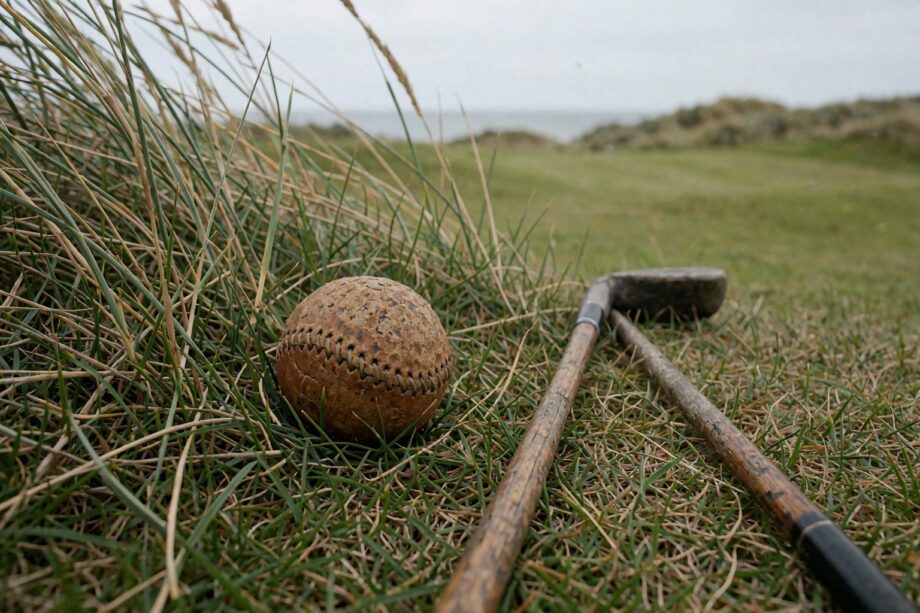
The featherie was a golf ball made by boiling feathers and packing them into a wet leather case, then stitching it shut and leaving it to dry so the leather shrank and the feathers swelled to pack it rock hard. It was golf’s standard ball for generations, right up until the gutta-percha “gutty” took over around 1848, and it sits at the heart of our plate, The Old Ball.
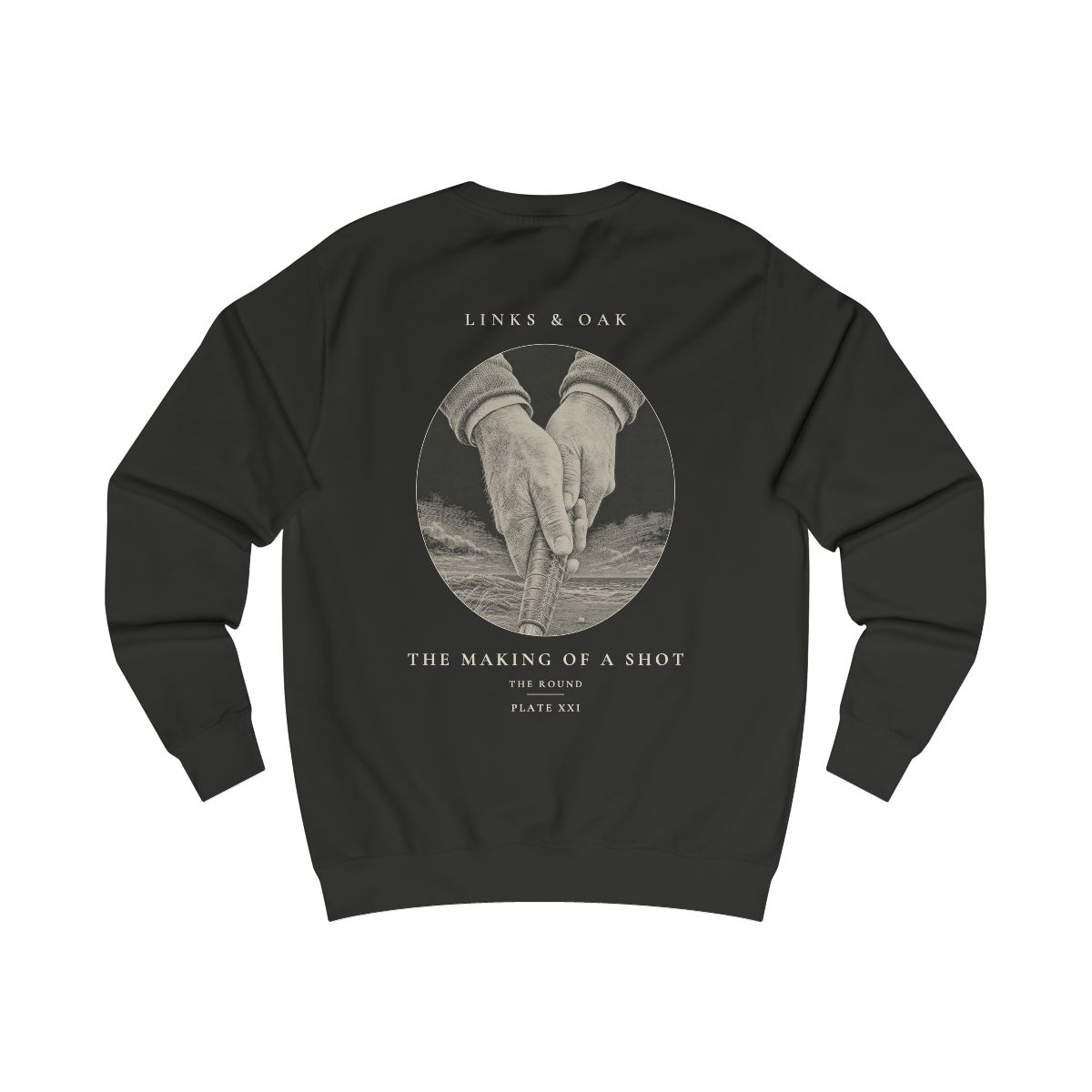
One thing first. Our plates are digital artwork in an engraving style. They are not antiques and they are not hand-engraved originals, and the scene does not show any real named course. What we can do is stay honest about the story behind the picture, and that story is a good one.
What was a featherie golf ball made of?
The featherie was a leather case packed hard with feathers. That is the whole idea, and it is also where the difficulty starts, because getting a great many feathers into a small leather sphere is much harder than it sounds.
The traditional description, repeated in golf histories for generations, is that a maker stuffed a top hat’s worth of feathers into each ball. It is best read as a rule of thumb rather than a measurement, but it gives you the right picture: a startling volume of loose feather squeezed down into something you could hold in one hand.
The process, as it is usually described, went roughly like this:
- The leather, commonly given as cow or bull hide, was cut into pieces and soaked so that it stayed supple.
- The pieces were stitched together inside out, with a small opening left unsewn.
- The case was turned the right way round through that opening, so the seams ended up on the inside.
- Feathers, boiled first to soften them, were forced in through the gap with a stuffing tool while the leather was still wet.
- The last hole was stitched shut, and the ball was left to dry and then given a coat of paint, usually white.
The cleverness lies in the drying. Wet leather shrinks as it dries, and wet feathers expand as they dry. Both happen at once inside the same little sphere, and the result is a ball packed so tightly that it becomes surprisingly hard. The maker was, in effect, letting two natural forces do the squeezing for them.
The stuffing itself was the punishing part. Accounts of the trade describe the maker leaning a stuffing tool against the chest and pushing feathers in by main force. That is why the old descriptions talk about the toll on the maker’s body. It was skilled work, but it was also hard on the person doing it.
Who made featherie golf balls, and how much did they cost?
Because each ball took so long, they were never plentiful. The figure most often quoted is that a good maker might turn out only a handful in a day, and you will see three or four given. Treat that as an estimate from the histories, not a fixed rule, but it tells you what kind of object this was. Every ball was somebody’s afternoon.
That scarcity is why makers were respected, and why some of them are still remembered by name. The best known of all is Allan Robertson of St Andrews, who is widely regarded as the first true professional golfer and who ran a successful business making featheries. He is a fitting name to hang this story on, because he sat at the exact moment the old ball ran into the new one.
Money is where the story gets interesting. The featherie was costly to produce, and it showed in the price. A commonly cited episode goes back to 1618, when James VI and I is recorded as granting a patent to an Edinburgh ball maker, James Melvill, giving him a monopoly on making the balls and, as it is usually told, fixing what they could be sold for. Details of that story vary a little between books, so we will simply say the tale exists and that it points to the same conclusion as everything else: a featherie was worth having and worth guarding.
We would rather not put a modern price on a ball from that era. Comparing money across centuries is a good way to write something impressive and wrong. What the histories do agree on is the broad shape of it. Featheries were expensive next to the ball that replaced them, and a player who lost or split one felt it.
Why did golfers stop using the featherie ball?
For all its faults, the featherie did the job. It flew well for its day, it could be struck cleanly, and nothing else on offer matched it. That is the honest reason it lasted so long. It was not loved for being perfect. It won by having no serious rival for a very long time.
Its weaknesses were plain to everyone who used one:
- Rain was its enemy. Water could get into the seams and spoil the ball.
- Hitting it badly, or with a club that bit too hard, could split the stitching.
- It was slow to make, so there were never enough, and a ruined ball was a genuine loss.
- No two were quite alike, because each was made by hand.
The end came with a material called gutta-percha, a rubber-like substance from tropical trees. It arrived in Britain in the 1840s, largely as packing and as a material for all sorts of household objects, and somebody worked out that it could be softened with heat and moulded into a ball. The result was the gutty, which is generally dated to around 1848. It was cheaper, it could be remade if it was damaged, and it did not care much about damp.
The accepted tale of the changeover involves Robertson himself. A maker of featheries had every reason to be nervous about a cheap moulded ball, and the well-known story is that he did not welcome it. He is said to have bought up gutties in order to get rid of them. It is a good story and it is widely repeated, though how much of the detail is embroidery is harder to say. What is safe to say is that a man whose living depended on the featherie had a great deal to lose.
The old ball did not vanish overnight. For a time both were in use, and the arguments about which was better must have been lively. But the economics were not on the featherie’s side. A ball you could mould was a ball anybody could make, and a ball that could be made in bulk was a ball more people could afford to play with. In a game that was slowly growing beyond a small circle of enthusiasts, that mattered a great deal.
It is worth pausing on that, because it changes how we should see the featherie. It was not a failure that was swept aside. It was a beautiful piece of handwork that suited a small, close game, and it was outgrown when the game grew. Golf went on to change its ball again, later in the century, so the gutty had its own turn as the old ball in due course.
The scene on the plate
When we drew The Old Ball, we wanted the quiet in it: the sense of one person, one hard stuffing job and one small round object that would soon be carried out on to the links. There is craft in every line of that scene, and none of it was invented for the picture. The stitching, the leather and the pile of feathers all come straight out of the history.
We make our designs for people who love this side of the game, the part that lives in old books and in the stories that get told at the end of a round. If you have ever looked at a modern ball and wondered where it came from, the featherie is the honest answer. It is a strange, laborious, brilliant thing, and it deserves a place on the wall or on the chest.
If that sounds like you, have a look at The Old Ball on the site. It is printed to order on our T-shirts, sweatshirts and hoodies, and it is our way of keeping a small piece of that story in circulation.
See it in the collection: The The Old Ball design