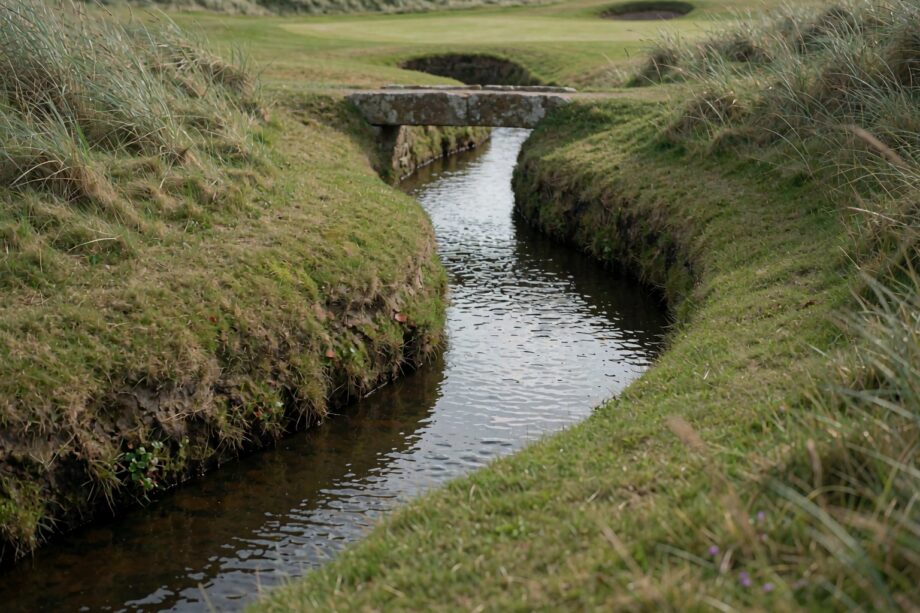
A burn is the Scots word for a small stream, and on links courses these streams were draining the low ground towards the sea long before anyone laid out a hole. Golfers arriving later simply found the water in the way, and over the years the game came to depend on it as much as it worked around it.
Nobody designed a burn into the old courses as a hazard in the modern sense. The early links were shaped largely by what the land already offered: the dunes, the hollows, the wind, and the water running through. The burn was there first.
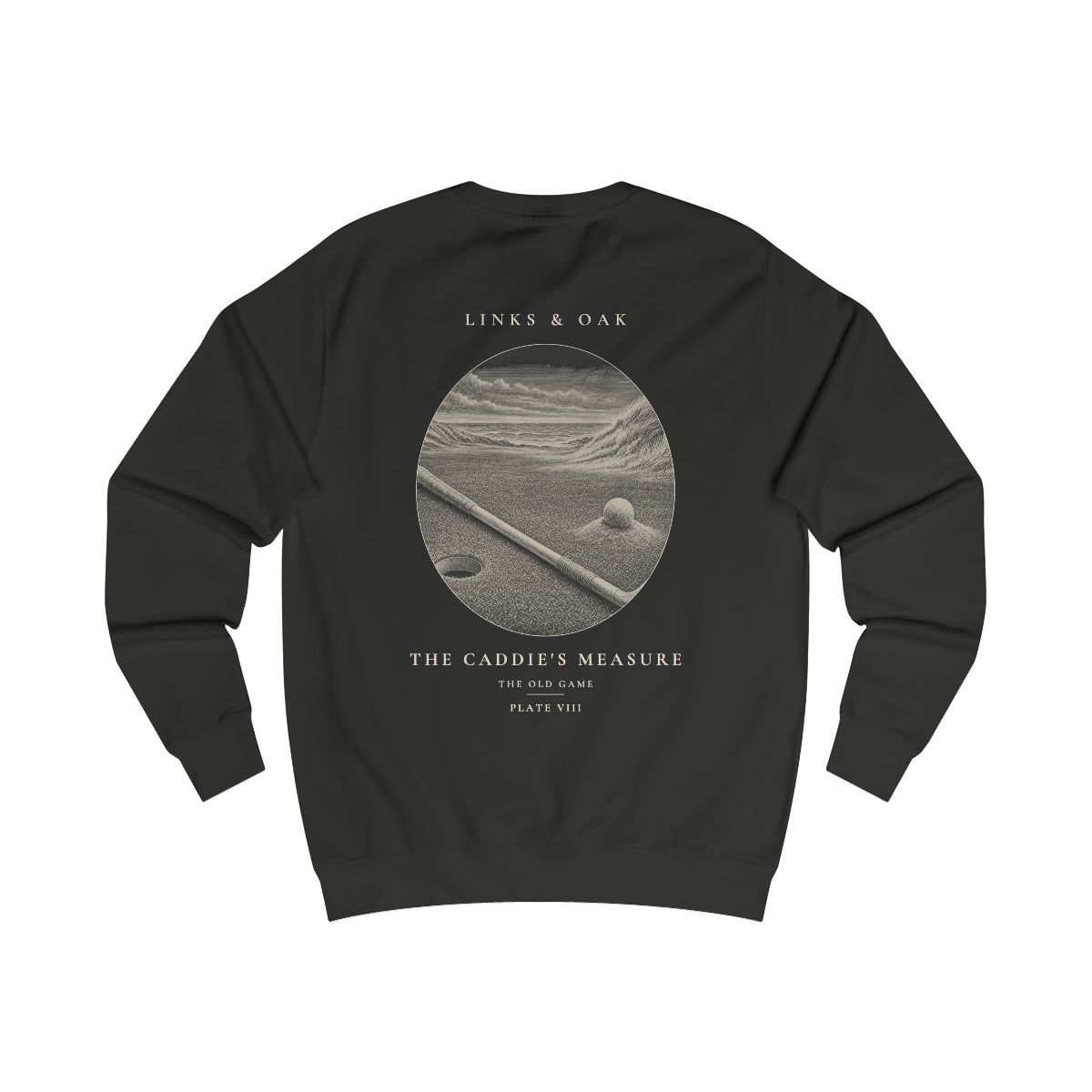
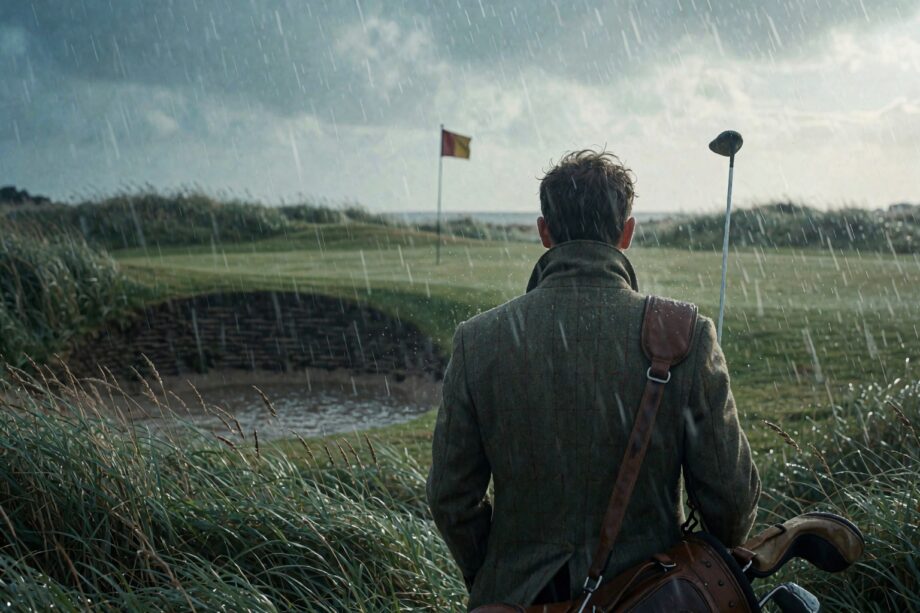
We are Links & Oak, and one of our plates is called The Carry. It shows the scene every links golfer knows: a shot that has to clear a burn before it can go anywhere else. We wanted to know the real story behind that scene, so here it is, kept to what can be supported.
What happens if your ball lands in a burn?
A burn has never been a decorative feature. It is a working piece of drainage, and on a links it tends to wander across the ground the way water does, which is to say without regard for a fair fairway. That is why you find the same pattern at several of the great old courses: a stream that comes into play at one or two holes, often near the start or the finish, and that the golfer has to think about whether they want to or not.
The rules have always had to say something about this. For a long time, water on a golf course was called a water hazard. If your ball ended up in it, you could usually play it as it lay, if you were brave and the ball was playable, or take a penalty stroke and drop behind it. Since the rules were modernised on 1 January 2019, the term is penalty area, and the choice is much the same: a penalty of one stroke to take relief. One change is worth knowing. Under the current rules you are allowed to touch the ground with your club in a penalty area, which was not the case before.
So when someone tells you a burn “cost” them a shot, that is quite literally the rule. And it is why the burns are remembered. Golf is a game of small penalties, and a stream is the most visible one there is. Everyone can see the water. Everyone knows what it means.
What is the Swilcan Burn at St Andrews?
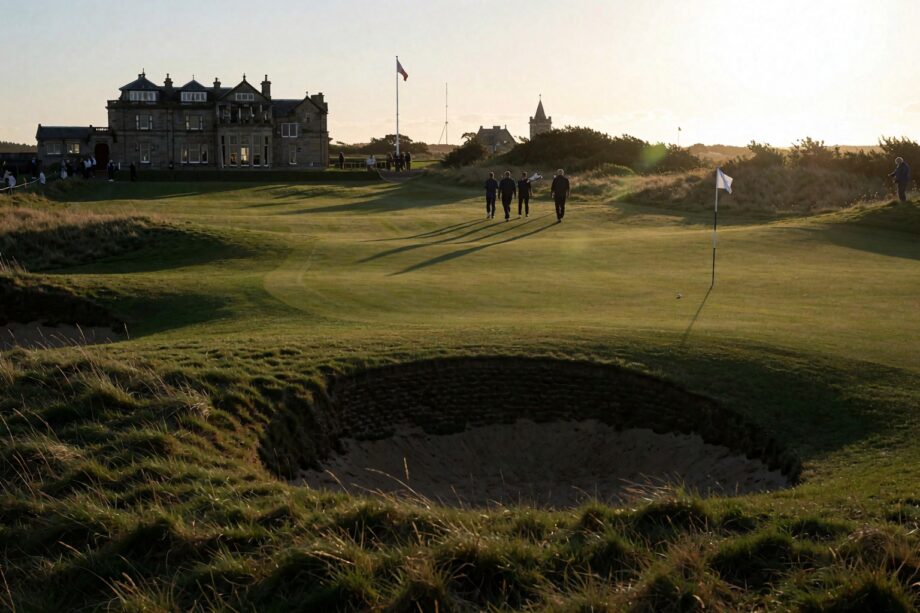
The most photographed burn in golf runs across the Old Course at St Andrews. The Swilcan Burn crosses in front of the first green and again in front of the final green, so the round begins and ends with the same small piece of water. Players cross the Swilcan Bridge, a low stone footbridge, on their way to the 18th fairway.
The bridge has become an image of the game itself. Two farewells are the ones people tend to remember. Arnold Palmer played his last Open Championship at St Andrews in 1995, and Jack Nicklaus played his in 2005. Both stopped on the bridge for the crowd. Those are well documented. It is the sort of moment where the golf stops mattering and the place takes over.
You will also hear that the Swilcan Bridge is ancient, sometimes that it is very many centuries old, sometimes that it goes back to Roman times. We have not found anything we can rely on to support a precise age, so we leave the figure out. What we can say is that it is a plain, old and much loved crossing, and that its age, like the age of the golf played beside it, is a matter of tradition rather than a signed and dated record. If a story about it comes with a confident date and no source, be a little suspicious.
The burn itself is a modest thing. Which is rather the point. On the Old Course the water is not dramatic. It is small, quiet and easy to underestimate, and that is exactly what makes a short approach to the first green feel so much larger than it looks from the tee.
What happened to Jean van de Velde at the Barry Burn?
If the Swilcan is the friendly one, the Barry Burn is the one with a reputation. It winds through the closing holes at Carnoustie on the Angus coast, and the finish there is regularly described as one of the hardest in championship golf. The burn crosses the 17th and then curls in front of the 18th green, which means a player standing on the last tee with a lead is still looking at water they have to respect.
The shot most people connect with it happened in the final round of the 1999 Open Championship. Jean van de Velde, of France, stood on the 18th tee needing only a double bogey six to win. What followed is well recorded. He played the hole aggressively and his approach shot struck the grandstand and came back into the rough, and his next shot found the burn. He took off his shoes and socks and stepped into the water to look at the ball, considered playing it, and then chose to take a drop with a penalty stroke. He finished with a seven, which put him into a playoff, and Paul Lawrie won it. Justin Leonard was the third man in that playoff.
We would say two things about that afternoon. First, it is remembered as a collapse, but it is more truthfully the story of a small stream and a run of decisions, each one understandable at the time. Second, the picture of a golfer with his trousers rolled up and his feet in a burn has become one of the most famous images in the game precisely because it is so ordinary. Anyone who has ever stood at the edge of a hazard and wondered can see themselves in it.
Carnoustie hosted a good many other Opens, and the burn has been part of the story for others too. But we will stay with what we are sure of. The Barry Burn is short on drama by size and long on it by history.
The Pow Burn and where the Open began
There is an older thread too. The first Open Championship was played at Prestwick in 1860, and it was won by Willie Park Senior. Prestwick has its own burn, the Pow Burn, which runs beside the opening hole. It is worth mentioning not for any single famous shot that we can source, but because it shows how far back this goes. From the very first championship, players were starting their rounds beside a bit of water that could ruin a good start.
We do not want to dress that up. We can say the first Open was at Prestwick, we can say who won it, and we can say the burn is there. What we will not do is invent a story of some legendary drive across it, because we cannot support one.
Why the carry stays with us
A carry is a simple idea. You hit the ball, and it has to stay in the air long enough to get over something. There is no sneaking round it. Either the shot is good enough or it is not, and everyone within sight of the tee can watch it happen.
That, we think, is why burns have lasted in golf writing and in golfers’ memories. A bunker asks you to be clever and a bit of rough asks you to be patient. A burn asks you to be honest about what you can do with the club in your hand. The good ones are narrow enough to look easy, and that is where the trouble starts.
A last note on what we make, because it matters to us that it is clear. Our plates are digital artwork in the style of an engraving. They are not antique, they are not hand-engraved, and they are not historical originals. The scene on The Carry is a scene of the game, and it does not show any real named course. The history above belongs to the real places we have named, and we have tried to keep it to what can be supported.
If you like the idea of that moment, the ball in the air and the water underneath it, you can see the plate on the site through the link below.
See it in the collection: The The Carry design