What does it take for a golf course to earn a nickname like “Car-nasty” from the professionals who play it for a living? Carnoustie golf course, on the Angus coast of Scotland, has carried that reputation for decades, and it has nothing to do with marketing. This is a links that has decided Open Championships on its own terms, most famously in 1999, using nothing more dramatic than wind, a burn that crosses the final two holes twice, and bunkers that punish the smallest loose shot. If you are weighing up whether to play it, or just want to understand why it keeps coming up in any serious conversation about links golf, here is what the course’s own history, its championship record and the people who have walked it actually tell us.
A links with centuries behind it
Carnoustie’s own history states that golf was played on the Barry links, the stretch of ground the course now occupies, as early as 1527, which puts it among the oldest places the game has been recorded anywhere. For most of its early life it was common land, used by local people long before anyone thought to lay out eighteen holes in order.
The course as golfers would recognise it today owes a great deal to Old Tom Morris, who extended and reworked the links in the 1800s, and to Allan Robertson before him. The bigger change came in 1926, when James Braid, five times Open champion and one of the most trusted course designers of his era, redesigned Carnoustie ahead of its first Open Championship in 1931. Much of what makes the course so testing now, the bunker placement, the use of the burn, the demand for precision over power, traces back to that redesign.
Carnoustie also has an unusual place in golf’s wider story. In the early twentieth century, a number of professionals and clubmakers trained on this links left for the United States, taking Scottish teaching methods with them. Stewart Maiden, who later coached the American amateur Bobby Jones at East Lake in Atlanta, was born and learned the game in Carnoustie. It is one of the clearer threads connecting this one stretch of Scottish coastline to the way golf developed on the other side of the Atlantic.
The holes golfers remember
Ask anyone who has played Carnoustie which hole stays with them and you will get a short list, not a long one. The 6th, a par five known as Hogan’s Alley, takes its name from Ben Hogan’s only appearance in the Open, in 1953. Hogan played a narrow line off the tee between out of bounds and a run of bunkers on all four rounds that week, on his way to winning the Claret Jug. The hole has carried his name ever since.
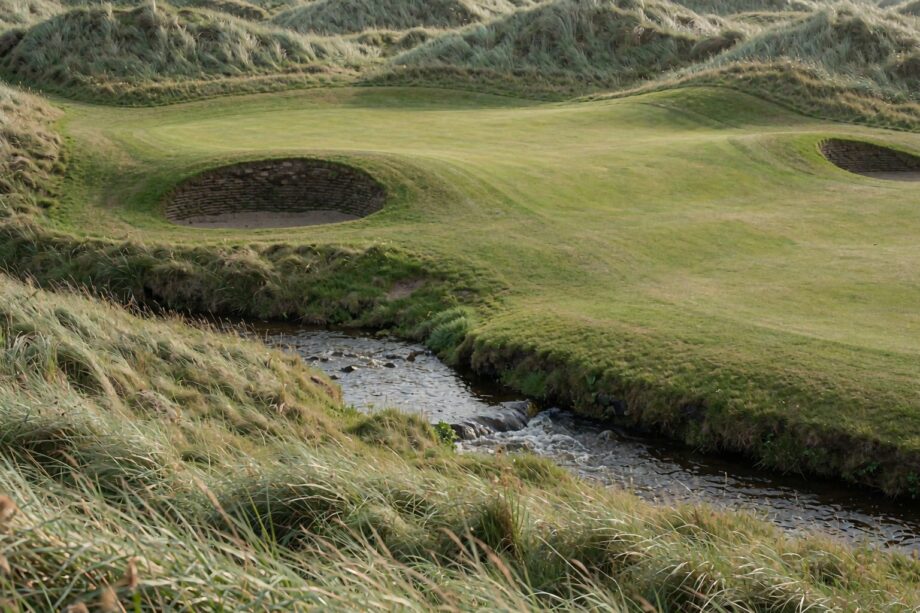
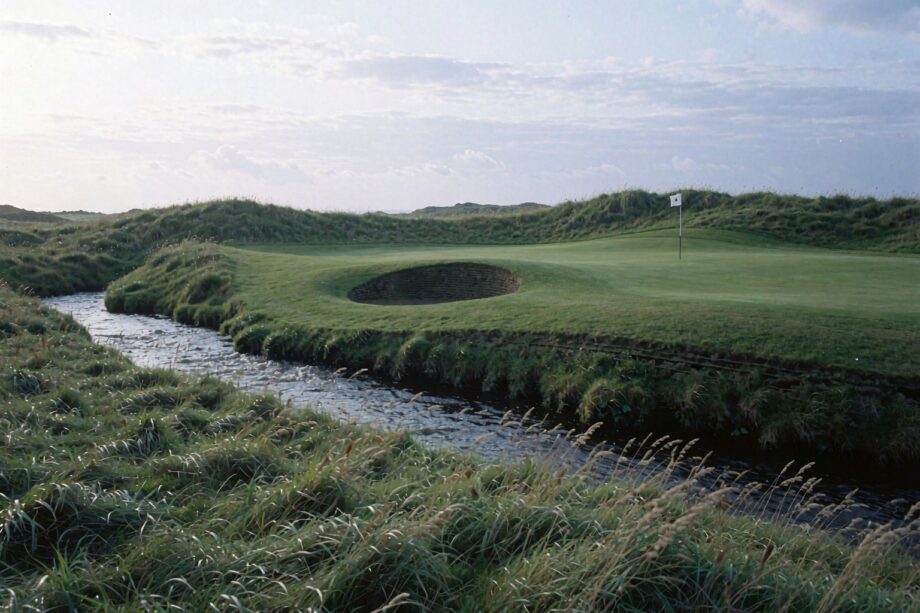
The 17th, known as Island, sends the Barry Burn across the fairway twice, forcing players to think carefully about where their tee shot and their approach will actually finish rather than how far they can hit. The 18th, called Home, is where the course has made its reputation. The burn sits directly in front of the green, and in the final round of the 1999 Open, Jean van de Velde arrived there needing only a double bogey to win. What followed, a wayward drive, a shot into the grandstand, a ball that finished in the burn itself, and eventually a shoe-off attempt to play it from the water before taking a drop, turned into one of the most talked about collapses in the sport. Van de Velde made triple bogey, fell into a three man playoff, and lost it to Paul Lawrie, who had started the final round ten shots behind the leaders. It remains one of the most referenced finishes in Open history, and it happened entirely because of what the 18th at Carnoustie demands from a player under pressure.
Why golfers call it one of the hardest tests in the game
Carnoustie has hosted the Open Championship eight times: 1931, 1937, 1953, 1968, 1975, 1999, 2007 and 2018, when Francesco Molinari won. That record alone places it firmly among the handful of courses the game’s organisers trust to produce a fair but searching test. What golfers and golf writers consistently point to is not a single fearsome hole but the accumulation of small decisions the course forces on every shot. The wind off the North Sea rarely settles, which means a club that worked on one hole can be wrong two holes later. The fairways are narrower than they look from the tee, the rough is thick enough to cost a shot outright, and the bunkers are deep rather than decorative.
None of this is new. Players on the professional tours have used some version of the “Car-nasty” nickname for years, and it tends to come from people who have just finished a round there rather than from anyone trying to be clever about it. The course does not rely on length to be difficult, which is part of why it has held up so well against modern equipment. It asks for accuracy and patience instead, and those qualities do not go out of date.
Playing Carnoustie yourself
Carnoustie Golf Links is not a single course but three: the Championship Course, which carries the Open history described above, and two others, Burnside and Buddon, which share the same stretch of coastline at a gentler level of difficulty. Visitors are able to book tee times on all three through the club directly, and because the Championship Course remains on the Open rota, demand for it can be high, particularly in the summer months. Anyone planning a trip is better served checking the club’s own website for current green fees, visitor rules and availability than relying on anything quoted secondhand, since rates and conditions change from one season to the next.
Caddies are available for visitors who want local knowledge of the burn crossings and the bunker lines, which is worth considering on a course where a misjudged line can cost more than a shot. As with any links course on this coast, the weather can turn quickly, and the people who seem to enjoy Carnoustie most tend to be the ones who have dressed for a Scottish afternoon rather than hoped for one.
What comes through in nearly every honest account of playing Carnoustie, whether from a golf magazine’s review or a club golfer talking about their own round, is respect rather than resentment. It is a course that beats you occasionally, rewards patience when you give it, and leaves you wanting to come back and do better. That is a fairly rare combination, and it is most of the reason Carnoustie’s name still carries weight in a conversation about links golf more than five hundred years after the first clubs were swung across that same stretch of ground.
At Links & Oak, this is exactly the kind of story that drew us to this game in the first place: not the scorecards, but the ground itself, and the centuries of people who have tried to master it. It is the same spirit behind the heritage designs we put together for people who love this history as much as the game.