What does the most famous golf course in the world actually ask of the golfer who turns up to play it? Not length, and not brute strength. The Old Course asks you to think your way round, to read ground that looks flat and plain until you are standing on it, and to accept that the course, not you, decides where the trouble is. That is the honest answer, and it is why golfers who come expecting a straightforward test often leave with a very different view of the place than the one they arrived with.
A course nobody designed
The Old Course was not laid out by an architect with a drawing board. It grew over centuries on a strip of natural linksland running along the edge of the town, ground that golfers had already been playing on for generations before anyone thought to shape it on purpose. A charter from the Archbishop of St Andrews in 1552 confirmed the townspeople’s right to play golf on these links, which tells you how far back the game here goes.
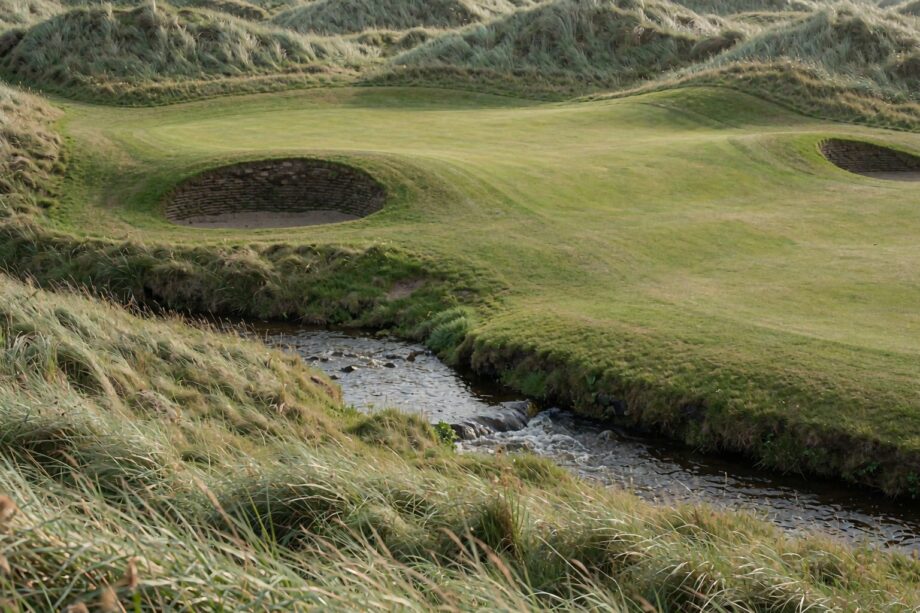
The man who did more than anyone to turn that rough ground into the course played today was Old Tom Morris, appointed Keeper of the Green at St Andrews in 1865. He widened fairways, reshaped several greens and had a hand in separating out the huge double greens the course is still known for. Most of the Old Course’s eighteen holes share their putting surfaces two to a green, seven double greens in all serving fourteen holes, which is why the fairways here are some of the widest in golf. That width is deceptive. A wide fairway sounds forgiving, but it gives the course room to tempt you into the wrong side of it, away from the best angle into a green that is often guarded on one side by a pot bunker you cannot see from the tee.
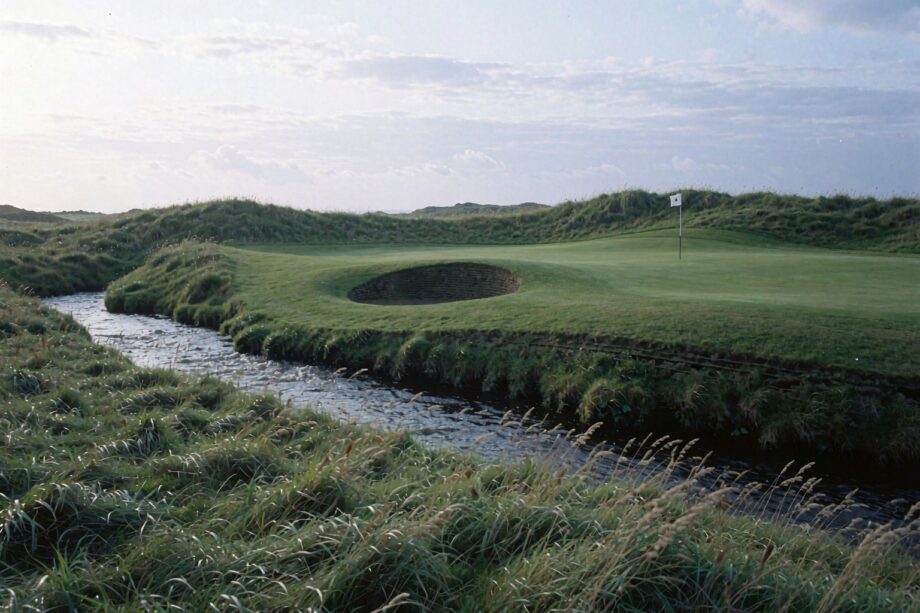
There is no rough in the way most golfers picture it, no trees to speak of, and very little that looks dangerous standing on the first tee. The danger is nearly all hidden, in bunkers sunk into the turf and humps and hollows that turn a straightforward-looking approach into a guessing game. Golf writers have made the same point for decades: the Old Course rarely punishes a bad shot as hard as it punishes the wrong shot played well.
The holes that decide the round
The first hole plays across the Swilcan Burn, a stream that crosses in front of the green and has swallowed more cautious approach shots than it has any right to, given how unthreatening it looks. It is a gentle opening by Old Course standards, which is deliberate: the course saves its teeth for later.
The fourteenth, known as Long, runs past Hell Bunker, a deep sand pit set well short of the green that has trapped professionals as readily as amateurs. It is one of the most feared bunkers on the course precisely because it sits in the landing area for a perfectly reasonable shot.
The seventeenth, the Road Hole, is the one golfers talk about most. The tee shot is blind over the corner of a building, a tradition going back to when railway sheds stood on that ground and golfers simply had to trust their line over them. The green is tucked hard against a road and a stone wall, both of which are in play and out of bounds, with the Road Bunker sitting just short of the putting surface on the approach side. In the 1978 Open Championship, Tommy Nakajima found that bunker and needed four shots to get out of it, carding a nine that is still remembered in golf history as the Sands of Nakajima. Few holes anywhere in the world have a single bunker with that kind of reputation.
The eighteenth closes the round with the Valley of Sin, a deep hollow short of the final green that has decided championships. Doug Sanders missed a short putt here in the 1970 Open and went on to lose the play-off to Jack Nicklaus, one of the most replayed moments in the sport. The hole is also where Nicklaus himself said his farewell to the Open in 2005, pausing on the Swilcan Bridge that crosses the burn beside the fairway, a photograph that has since become something close to a ritual for players finishing their last competitive round at St Andrews.
Why golfers argue about it
Ask golfers what they thought the first time they played the Old Course and you will hear two very different answers. Some find it plain, even underwhelming, a flat stretch of ground without the dramatic elevation or scenery of a course cut into cliffs or dunes elsewhere in Scotland. Others, often on a second or third round, describe a course that rewards study the way few others do, where knowing which side of a fairway to favour and which bunker to play away from matters more than how far you hit the ball.
That split opinion is not new. Golf magazines reviewing the Old Course over the years have tended to agree on one thing even when they disagree on everything else: it is a course you have to play more than once to judge fairly. The Royal and Ancient Golf Club, based in the clubhouse beside the first tee, has staged the Open Championship at St Andrews more times than at any other venue, including the 150th Open in 2022, and the course’s standing as the sport’s oldest and most repeated championship test is part of why so many golfers want to play it at least once, whatever they make of it afterwards.
How to get a round
The Old Course is public, run by the St Andrews Links Trust rather than a private members’ club, which is part of what makes it unusual among courses of its fame. Visiting golfers generally get a tee time one of two ways: through an advance reservation applied for well ahead of the year they want to play, allocated by ballot, or through the daily ballot, which golfers already in the town can enter a couple of days before they hope to play. A small number of places are also kept for single golfers without a group, who can be paired with others on the day.
First-time visitors are strongly advised to take a caddie. Given how much of the course’s trouble is hidden rather than obvious, a caddie who knows the ground can save strokes that no amount of course knowledge gained from a map or a review ever will.
One detail surprises visitors every time: the Old Course does not open for golf on Sundays, except during Open Championship weeks. Instead it rests, and the town uses it as a public park, with locals walking across the very fairways that will be lined with grandstands the next time the Open comes round. It is a reminder that this is still, at heart, the town’s own ground, long before it was anyone’s idea of a bucket-list round.
What does not change, whatever the fees and ballots look like in any given year, is the experience waiting on the first tee: a course with centuries behind it, asking you to think before you swing. It is that kind of story, the long, unglamorous history behind a famous round of golf, that Links & Oak’s own engraving-style designs are built to carry, for golfers who want to keep a piece of links golf’s heritage close even when they are nowhere near a links course themselves.