
Before the wooden peg, golfers made their own tee by hand: a small pinch of wet sand, patted into a firm little mound to raise the ball off the ground. It is written into the oldest surviving rules of golf, the 1744 code drawn up in Edinburgh for a competition at Leith, which required the tee to be “upon the ground” – and it stayed the standard method for the best part of two centuries, until patented peg tees arrived at the turn of the twentieth century.
Picture the first tee at first light: the grass grey with dew, a golfer crouched over a small pile of sand, patting it into shape with a wet hand. No peg, no plastic, just sand, a thumb and a little patience. That is the scene on one of our plates, and here is how much of it is record rather than romance.
What did golfers use before the tee peg was invented?
Here is the first thing worth knowing. For a long time, a tee was not an object you carried. It was a place, and later a small mound you made in that place.
The earliest written rules we can point to are the thirteen articles drawn up for the Gentlemen Golfers of Edinburgh in 1744, for a competition played at Leith. They are usually described as the oldest surviving code of golf rules, and they were later taken on by the Honourable Company of Edinburgh Golfers. The opening rule says a player must tee the ball within a club’s length of the hole. The second says the tee must be upon the ground.
Read that slowly, because it tells you a lot. The ball was teed near the hole you had just finished, not on a separate, mown platform set back down the fairway. And “upon the ground” tells us the tee was built from the ground itself, not lifted onto a bought accessory. The ball sat on a little heap of earth or sand raised from the course.
Where did the word itself come from? Honestly, nobody can say for certain. Dictionaries record the origin as uncertain, and there are several tidy explanations doing the rounds. We would rather tell you the origin is unknown than give you a neat story we cannot back up.
The pinch of wet sand and the box on the tee
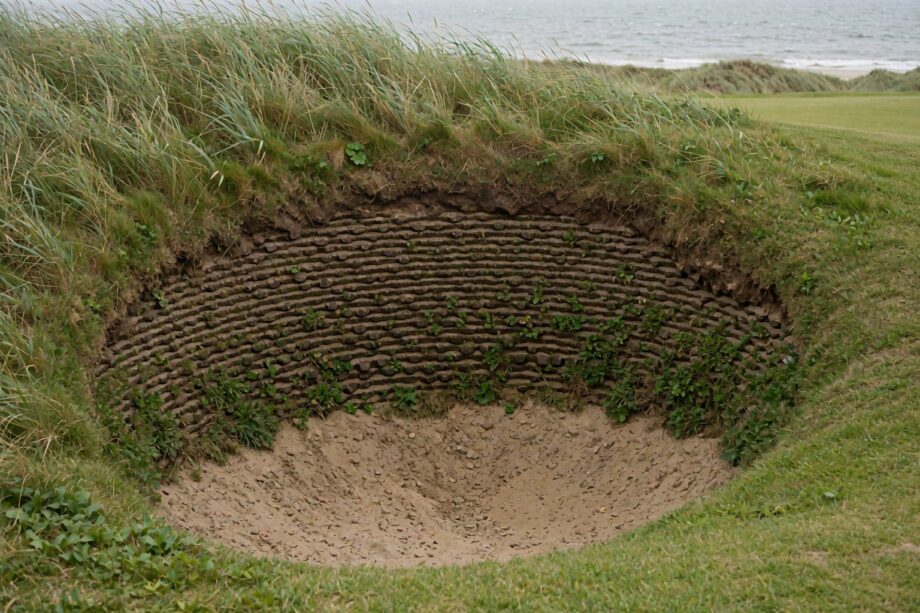
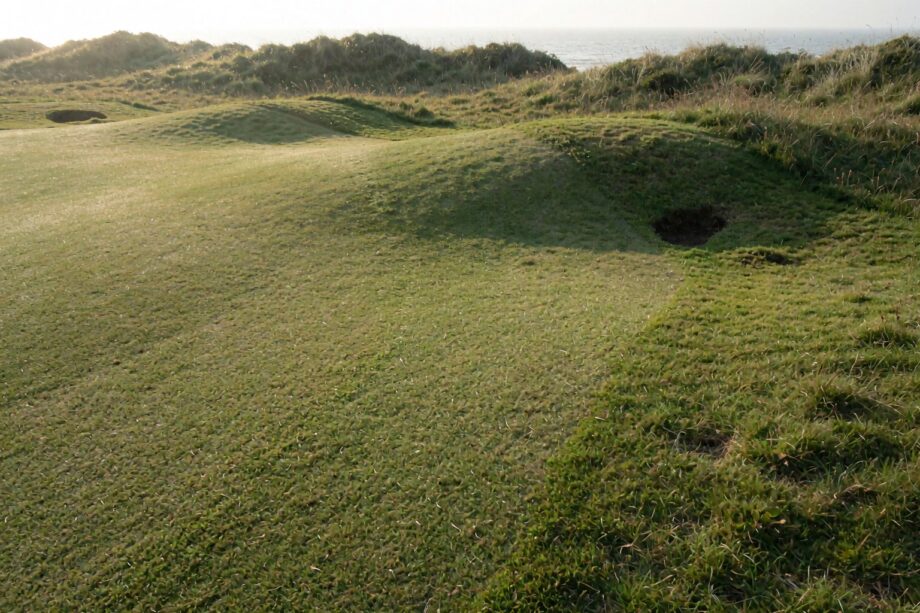
Links land is sandy by nature. It is the ground between the sea and the farmland, shaped by wind and rabbits and centuries of grazing, and sand was simply to hand. Golfers of the early game raised a small cone of it, set the ball on top, and played from there.
Dry sand will not hold a shape, which is why it was wetted. A little water, a pinch of sand, a pat with the fingers, and you had a firm little pedestal. It was fiddly, and it was slow, and it left your hands gritty. Yet it worked, and it worked for generations.
As the game grew more organised through the nineteenth century, courses began to make this easier. Wooden boxes of sand, often with a little water alongside, were kept at the tee so that players did not have to scrape sand from the ground each time. Many old golfing accounts and photographs from the period show these boxes. They are a lovely piece of everyday golf furniture, and they explain something else too: the tee ground itself gradually became a defined, separate place, because that was where the box lived.
Often it was the caddie who did the building. That is an entirely believable division of labour, and several writers on the early game describe it, but we would not claim a rule that it was always so. What we can say is that making the tee was part of the routine of the round, as much as choosing a club.
Why the routine mattered
It is easy to look back at all this and see only inconvenience. We think that misses something.
Building your own tee forced a pause. You crouched, you shaped, you looked down the hole ahead of you. You could not rush it. Golfers who have played on windy links will tell you a well-made mound of sand is not an idle detail, since the height you chose was a small decision about how you meant to hit the shot. Too high and the wind would have the ball. Too low and you were fighting the ground.
There is also a plain point about equipment. In this era the game asked very little of anyone’s bag. A few clubs, some balls, and the ground itself. The tee was part of the landscape rather than part of the kit, and we find that rather appealing.
The routine did have its critics, though. It was slow, it was messy, and the sand boxes could turn into a small nuisance on a busy day. So it is no surprise that, once the game began to boom, people started looking for something quicker.
Who invented the golf tee?
This is where the story gets tangled with myth, so let us keep to what can be supported.
The first patented wooden golf tee we can point to is credited to Dr George F. Grant, a dentist from Boston, in 1899. Grant was Black, and he is recorded as the first African American to graduate from Harvard’s dental school and to serve on its faculty. He was also a keen golfer. His tee, a wooden peg with a flared top, was patented in December 1899, but he did not push it commercially, and reportedly gave many away to friends. That is a large part of why his name went unrecognised for so long.
It is often said that Grant “invented the tee”. That is a claim we would soften. Golfers had been raising their balls on sand for centuries, and other tees, including rubber and cardboard designs, appeared in the years around 1900. What Grant is properly credited with is the first patented wooden peg tee. That is a real achievement, and it does not need to be inflated.
The peg that most golfers would recognise as the popular successor came a little later. In the early 1920s, a New Jersey dentist named William Lowell developed a tee he sold as the Reddy Tee, and it is generally credited with making the peg widely popular. Yes, another dentist, which is one of those coincidences of golf history we simply enjoy. Lowell is reported to have promoted the tee through professional golfers of the day, which helped it catch on. We would not put a firm number on how quickly it spread, because the sources vary.
By the time the peg took hold, the sand box had begun its long retreat from the tee. In time it disappeared altogether. Now nobody would think to look for one.
What we kept, and what we did not claim
A few notes on honesty, since it matters to us. The plate we made is digital engraving-style artwork. It is our own drawing in an old manner, not an antique print, not hand-engraved, and not a historical original. It does not show a real named course either. It shows a scene, the kind of scene that would have been familiar on any stretch of links land: the early light, the flag in the distance, a golfer building a tee.
We chose it because that small act says so much about the old game. It was patient. It was physical. It was close to the ground, both literally and in spirit. It asked you to slow down before you swung.
The next time you push a peg into a tee box without a thought, spare a moment for the pinch of wet sand. It is worth remembering that for most of golf’s story, this is how it began.
If that quiet first-light moment appeals to you as much as it does to us, you can see the plate itself, and the way we have set it as a design for everyday wear, just below.
See it in the collection: The First Light on the Links design