Long before anyone was paid to do it, links turf was kept short by grazing sheep and rabbits, and it stayed that way until scythes, then Edwin Budding’s 1830 mower, gave clubs the means to cut greens by hand and machine themselves. Named keepers like Old Tom Morris, who took charge at Prestwick in 1851 and St Andrews in 1865, are among the few whose work survives in the record.
We are a small brand that loves the old game, and the plate we call Out Before Eight is our tribute to that early work. Some of what follows is well documented; some is repeated so often it has taken on the shine of fact without much to hold it up. We will try to say which is which, and where the record goes thin, we will say that too.
How was grass on old golf links kept short before machines?
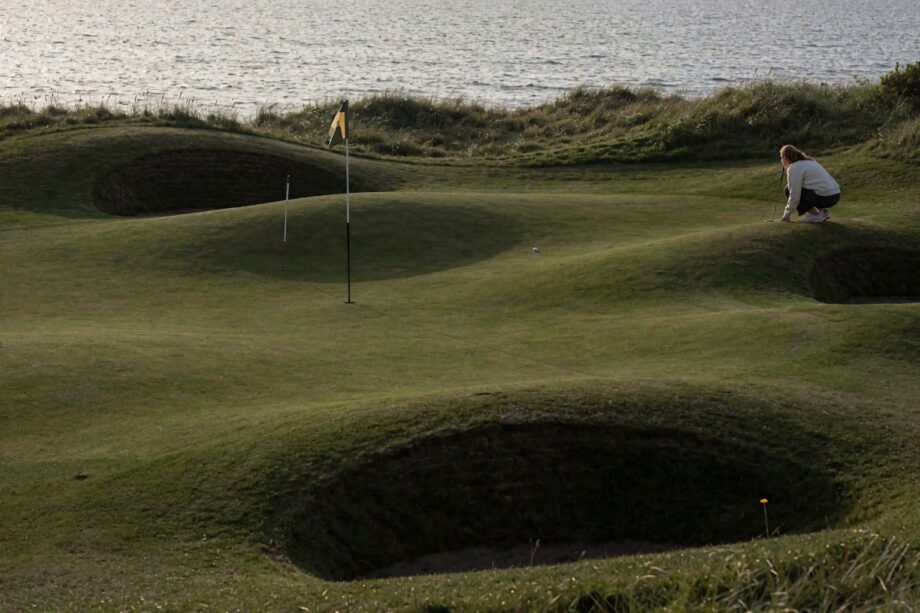
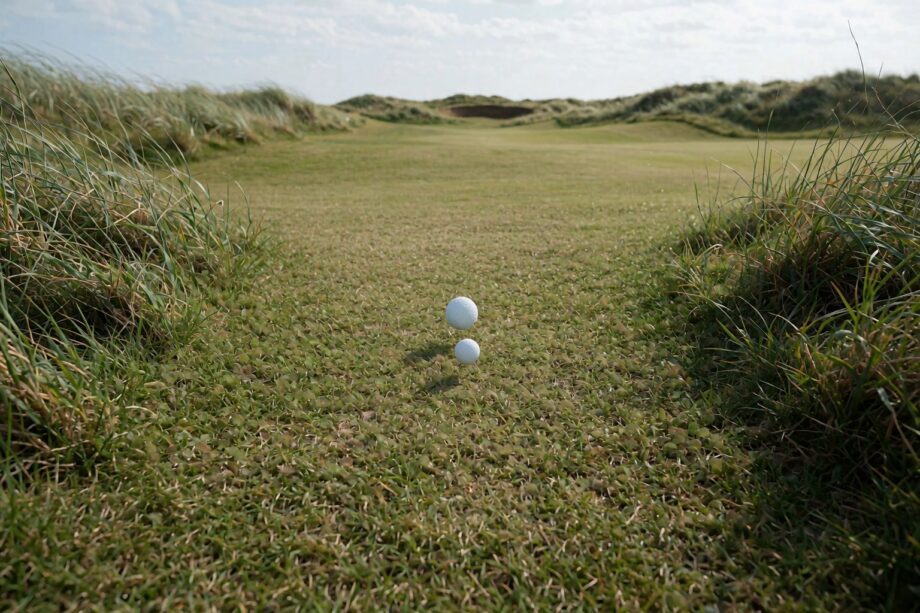
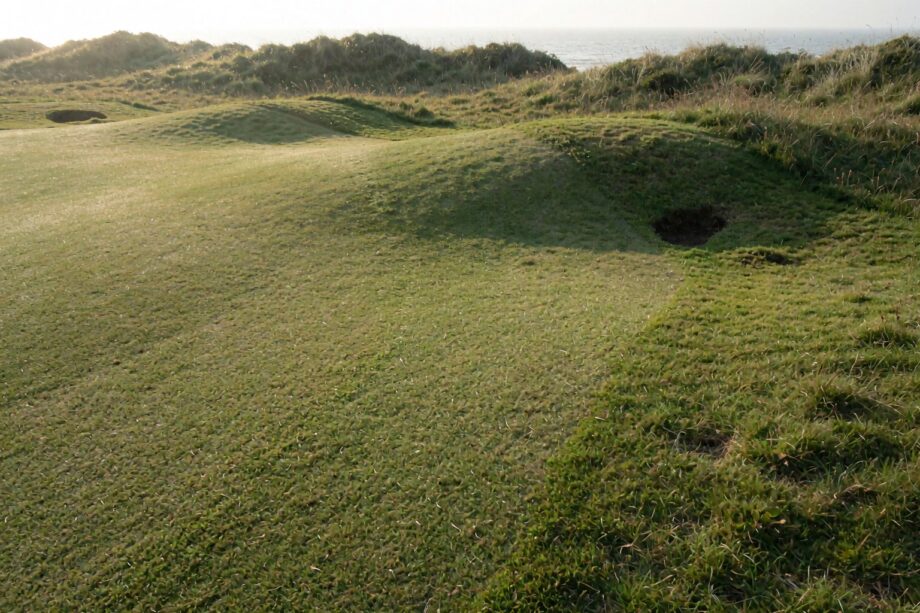
Start with the ground itself. The old links of Scotland sit on sandy, wind-blown land between the shore and the farmland, and that land was used long before anyone thought of it as a golf course. It was common grazing. Sheep, and rabbits in great number, kept the turf short, and it is widely accepted that this short, tight turf is a large part of why the game took root on that kind of ground in the first place.
That matters for the picture of a “greenkeeper”. In the earliest centuries of the game there was very little to keep. Players hit the ball over ground that animals had already trimmed. The hollows scraped out by sheep sheltering from the wind, and by rabbits burrowing, are often given as the origin of the first bunkers. It is a sensible explanation and it is commonly told, though nobody can point to a single founding hollow, so we would hold it as a likely account rather than a proven one.
There was also no such thing as a green in the sense we mean today. The first written rules we have, the thirteen articles drawn up in 1744 for the Honourable Company of Edinburgh Golfers, who then played at Leith, ask that the ball be teed on the ground within a club’s length of the hole. In other words, the next tee was practically beside the last hole. The idea of a specially prepared putting surface, kept apart from the rest of the ground, came later. So did the idea that someone should be paid to look after it.
Scythes, hand mowers and the arrival of the machine
Once clubs wanted better surfaces, the tools were the ones any estate or village would have had. A scythe in skilled hands can leave a surprisingly even cut, and cutting by hand was how grass was managed before the lawn mower. That machine has a clear paper trail: Edwin Budding, of Stroud in Gloucestershire, patented a cylinder mower in 1830. It was designed for lawns and sports grounds, and it took time to spread. Early versions were pushed by hand, then heavier ones were pulled by a pony or horse.
Here is a detail that turns up often in the histories of horse-drawn mowing: the animal was fitted with leather boots so its hooves would not mark the turf. That is a lovely image and it is well attested for lawns and sports grounds in the later nineteenth century. What we cannot honestly tell you, without a source in front of us, is which particular links used horses in a given year. So we will not put a horse on a named course. Engine-driven mowers came in around the turn of the twentieth century, which is later than most people assume, and until then the work was largely muscle, a sharp blade and a great deal of walking.
Other jobs filled the greenkeeper’s day, too. Holes had to be cut, and cut again as the turf wore. Divots and worn patches needed attention. Ground had to be swept, rolled and drained. Weather did the rest. None of this was glamorous, and very little of it was written down at the time, which is exactly why so much of the old routine has to be pieced together from club minute books and later recollections.
Who was Old Tom Morris?
The person most often named in this story is Tom Morris, known to everyone as Old Tom. He was born in St Andrews in 1821 and learned the trade of ball making and the game itself in the town. In 1851 he moved to Prestwick on the Ayrshire coast, where he was engaged to lay out and look after the links. He is credited with the original twelve holes there, and Prestwick hosted the first Open Championship in 1860. That much is solid, and it is a fair reminder that the man who prepared the ground and the man who played on it were often the same person.
In 1865 he came home to St Andrews as keeper of the green, a post he held for decades, into the early 1900s. He died in 1908. During those years he is remembered for practical, patient improvements to the turf. One that is regularly credited to him is the habit of spreading sand over the greens to help the grass grow and to keep the surface true. It is often told that he noticed the benefit for himself. We would say that the practice and his association with it are well recorded, while the exact moment of the discovery is the sort of tidy story that tends to grow in the telling.
He also did something quieter that changed how the game is played. As numbers grew at St Andrews, the old habit of playing out and back over the same ground began to cause trouble. Players heading in and players heading out met on the same stretches, and separate greens and holes for each direction became the sensible answer. It is a good example of why a greenkeeper’s opinion mattered: the keeper saw where the ground was being worn and where the golfers were getting in each other’s way.
Old Tom is the name that survives because he was also a champion’s father and a fine player in his own right. There must have been countless keepers on other links whose names never made it into print. That is a real gap in the record, and it is worth being plain about it. When we say “the documented greenkeepers of the old links”, the list is short, and it leans heavily on one remarkable career.
Why is a golf hole 4¼ inches wide?
You may have heard that the size of the hole, four and a quarter inches across, came from a piece of drainage pipe, or from a tool used to cut holes at Musselburgh. It is a favourite tale. The dimension itself is certain: the R&A set it in its rules in 1891. The story of the pipe is the part we would call a story. It might be true, but we have not seen it nailed down, so we pass it on only as something people say.
Why we drew the early morning
The plate Out Before Eight is our own digital artwork in an engraving style. It is not an antique, it is not hand engraved, and it does not show any real named course. It is a scene we imagined from what the history tells us: the empty links, the low light, and the person whose job it is to make the ground ready for everyone else.
We put it on shirts, sweatshirts and hoodies because we think the people behind the game deserve a place on the chest as well as in the footnotes. If you love the old links, and you have ever wondered who made the turf fit to play on, you can find the design on our site, printed to order in the UK or the USA.
Next time you walk out to a green at a quiet hour and find the cut fresh and the dew still on it, spare a thought for whoever got there first.
See it in the collection: The Out Before Eight design