
Wind pushed early golfers to keep the ball low, landing it short of the target and letting it run along firm turf, because a ball hit high into a coastal gale rarely finished where it was aimed. Gorse, the thorny evergreen shrub that already grew wild on the poor, sandy dunes, became the game’s oldest hazard simply because it was there first, not because anyone chose to put it in play.
The scene on our plate “Against the Wind” is built around that feeling: a golfer leaning into a gale, gorse in the foreground, open ground beyond. We wanted to write down what is actually known about how wind and gorse came to define the old game, and to be plain about the parts that are only legend.
Where does the word ‘links’ come from?
The word itself points at the land. “Links” comes from the Old English hlinc, meaning a ridge or rising ground. In Scotland it came to describe the sandy, grassy, undulating strip of coast that lies between the beach and the farmland behind it. This was ground that was poor for crops. Blown sand, thin soil and salt air do not make good fields.
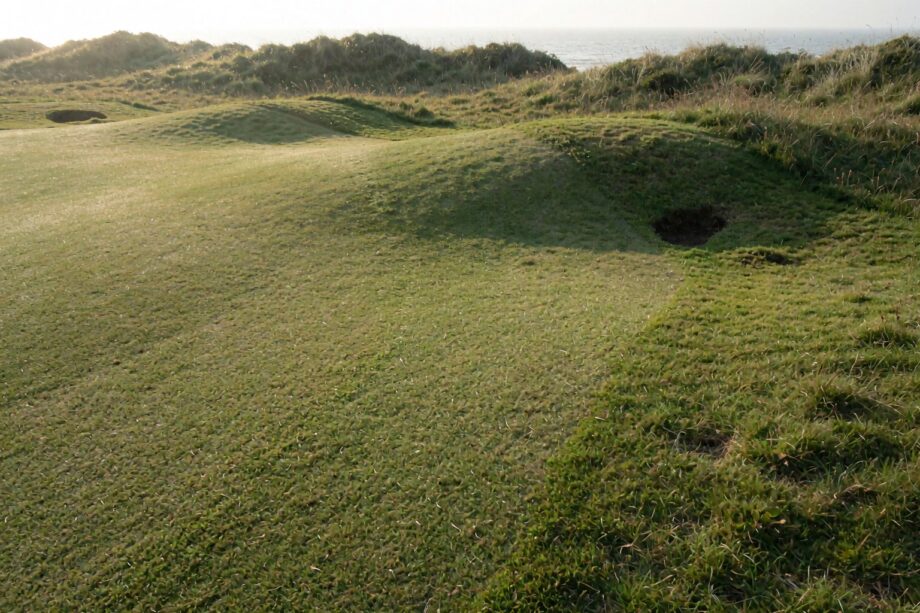
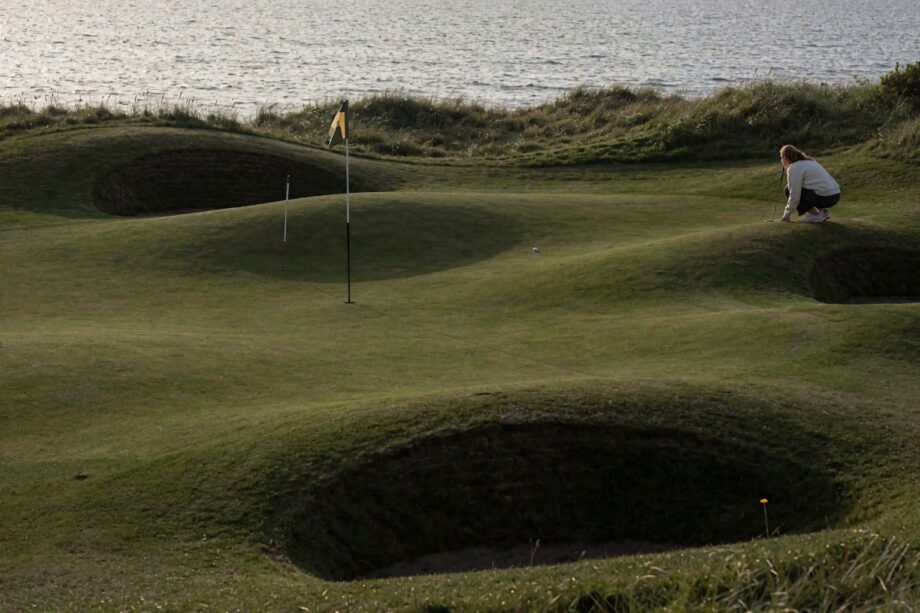
That poor ground turned out to be ideal for a stick-and-ball game. Wind had built it. Dunes form where sand blown off a beach is caught and held, and the hollows and ridges that golfers still play over are the result of sand shifting over centuries. Where the covering of grass broke, the wind scooped the sand out into bare hollows, often called blowouts. Grazing animals, sheep and rabbits, kept the turf that survived short and tight. Nobody planned any of it. The game found a landscape that was already there.
The earliest firm written evidence of golf in Scotland is not flattering to the game. In 1457 the Parliament of Scotland, under James II, asked that “futeball and golfe” be “utterly cryit doun”, because men were playing them when they should have been practising archery. Later acts, in 1471 and 1491, repeated the complaint. It tells us the game was popular enough to worry the Crown by the middle of the fifteenth century. It does not tell us where, exactly, or on what kind of ground, and we would rather say so than pretend. What we can say is that the coastal links of Scotland are the setting the game is most closely tied to in the records that survive.
How did wind shape the way golf was played?
Ask a links golfer what makes the game different and most will say the wind before they say anything about the turf. There is a simple reason. On open coastal ground there is little to stop it. Trees are scarce, and the land is low, so the weather arrives at full strength and changes direction with the tide and the time of day. A hole that plays one way in the morning can play as a different hole after lunch.
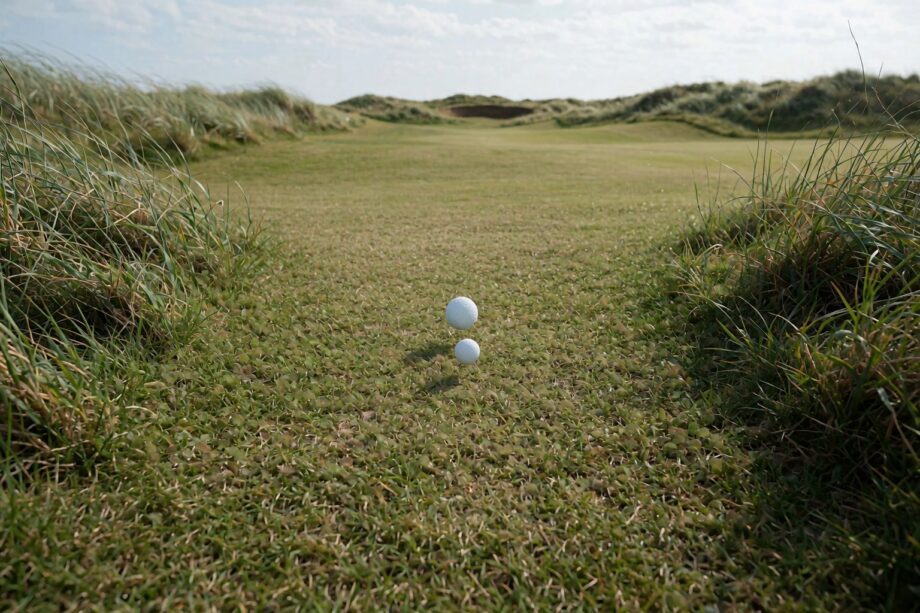
That shaped technique long before anyone wrote it down as advice. Think about what a headwind does to a ball struck with plenty of backspin: it climbs, hangs, and can end up well short of where you meant. A crosswind pushes it sideways, and the higher it flies, the longer the wind has to work on it. The answer players arrived at, generation after generation, was to keep the ball low and let the ground do part of the work. This is the ground game, and it is what people mean by the bump and run: a lower flight, a landing short of the target, and a run along firm turf.
The equipment of the time pushed the same way. For about two centuries the ball was the featherie, a leather case stuffed with feathers and stitched shut. It was expensive to make and did not fly like a modern ball. From about 1848 it was replaced by the gutta-percha ball, the “gutty”, made from the dried sap of a tropical tree and far cheaper. Then, around the turn of the twentieth century, the rubber-cored Haskell ball arrived and changed distance and flight again. Each change altered how a golfer had to think about the wind, but none removed the need to. A links golfer in every one of those eras had to think about where the wind was coming from before choosing a club.
There is one more thing the wind gave the game, and it is easy to miss. It gave it a routine of small decisions. Do you take more club? Do you aim well off the line and let the breeze bring it back? Do you play the low one you have practised, or trust the high one? Those questions are a large part of why the old courses are still loved. They are not solved by strength alone.
Why is there gorse on golf courses?
Now to the plant in the foreground. Gorse, Ulex europaeus, is an evergreen shrub covered in spines, with bright yellow flowers that smell faintly of coconut. In Scotland it is often called whin, and in parts of England, furze. It thrives on the poor, sandy, free-draining soil that links land is made of. Like other members of the pea family, it can fix nitrogen from the air, which helps explain how it copes where little else will.
Gorse was not put on links courses as a hazard. It was already there, and it had a working life long before golf. Historically it was used as fuel, as a hedge or windbreak, and, once crushed, as winter feed for livestock. The old rural saying that “when gorse is out of blossom, kissing is out of season” is a joke about the fact that some gorse is in flower at almost any time of year. It is a folk saying, not a fact to cite, but it captures how familiar the plant was to people who lived on this kind of ground.
For golfers the story is different. A ball that goes into thick gorse is very often a lost ball, and one that can be found may be impossible to hit cleanly. The rules of golf give the player options for a ball that cannot be played, at a cost of a stroke. They also set a time limit for looking. Since the 2019 revision of the rules that limit is three minutes; before that it was five. Anyone who has watched a friend hunt for a ball in gorse with a club, a glove and a growing sense of injustice will understand why the shorter limit was welcomed by some and mourned by others.
Gorse also does something to the look of the place. Its dark, dense green sits against pale sand and tawny grasses, and in flower it lights the whole edge of a fairway. Artists and photographers of the game have been drawn to it for a reason. It says at once that this is wild ground that golfers have borrowed, not land that has been tamed for them.
What is documented, and what is only told
We said we would be honest about the myths, so here they are.
It is often said that bunkers began as scrapes made by sheep sheltering from the wind, and that golfers simply started playing out of them. It is a lovely story, and it is plausible: livestock do wear hollows in exposed ground, and the wind will enlarge them. But it is a widely repeated account, not one we can trace to a firm dated source, so we treat it as likely in spirit and unproven in detail.
The same goes for any tidy tale of who first “designed” a links. Most of the early holes were found, not built, and the routing of the old courses grew from paths and habits. One real, documented change is worth knowing: at St Andrews the course was reduced from twenty-two holes to eighteen in 1764, and that is a large part of why eighteen became the standard. Even that, though, was a matter of a particular course settling on a number, not a rule handed down for all golf.
What we can say with confidence is simpler. The game grew up on wind-built, sandy coastal ground. The ground game grew out of the need to keep the ball under the wind. And gorse, an ordinary plant of poor soil with a long working history, became part of the character of those places, whether golfers wanted it or not.
The scene on the plate
That is the picture behind “Against the Wind”. A figure leaning into the weather, gorse close by, the land open and exposed beyond. It is not a portrait of a real named course. It is digital artwork in the style of an engraving, made by us, and we would never dress it up as an antique or a hand-engraved original. What we hope it does is catch the feeling of a game that was shaped by weather and by rough ground, and which is still played there today, with the same small negotiations with the breeze.
If you love the old game, and especially if you have ever finished a round on a links feeling scoured and oddly happy, you will know the scene. You can see the design on our site through the link below.
See it in the collection: The Against the Wind design