
A round of golf is 18 holes because of a decision made at St Andrews in 1764. The Society of St Andrews Golfers, the body that became the Royal and Ancient, found the first holes on the links too short and merged four of them into two, cutting the outward stretch from eleven holes to nine and shrinking a full round from twenty-two holes to eighteen.
It was a practical fix to one course, not a rule laid down for the whole game, but the rest of golf slowly came round to it anyway. We think that is a better story than the whisky-bottle myth, and it is the one we want to tell here, because it sits behind one of the scenes in our engraving-style artwork: golfers on foot, walking a links from first hole to last.
How many holes did golf courses have before eighteen?
Golf at St Andrews is far older than any rule about how many holes make a round. The game was being played on the links there long before anyone wrote down a standard. What matters for our question is the layout the golfers were using by the middle of the eighteenth century.
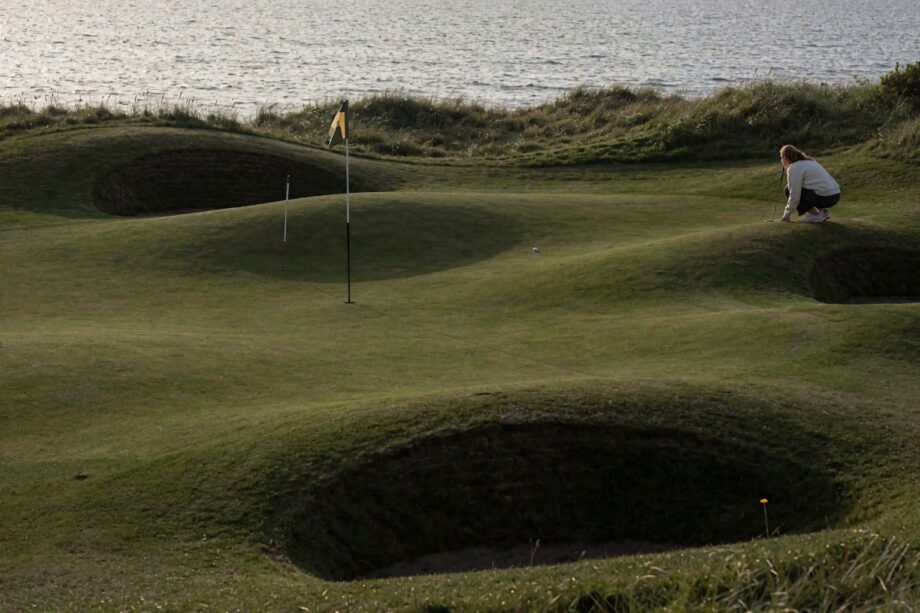
The links at St Andrews is a narrow strip of ground running out along the shore and back again. Golfers played out along it to a set of holes, then turned and played home along the same strip. The layout had eleven holes going out. You then played those same eleven holes coming back, which made twenty-two holes in a full round. Ten of the twelve holes on the ground were played twice, and the two at the far end were played once.
That sounds odd to modern ears, but the ground explains it. There was no room for a separate loop. The land was a strip, and the holes were laid along it in a line. Going out and coming back over the same holes was simply how you used the space.
It also shows something about how the game worked then. A round was not a fixed unit of eighteen anything. It was whatever the ground gave you. Other links had their own arrangements, with different numbers of holes, and nobody thought that was strange, because nobody was trying to compare a round at one place with a round at another.
1764, and the four short holes
By the 1760s the golfers at St Andrews were organised. The Society of St Andrews Golfers had been formed a decade earlier, in 1754, and it played for a silver club. It was the body that later became the Royal and Ancient Golf Club of St Andrews. When its members met in October 1764, they looked at the opening stretch of the course and made a practical change.
The first holes on the links were short. The Society decided that the first four of them should be combined into two. That took the number of holes on the ground from eleven going out to nine. Nine out and nine back gives eighteen. The round shrank from twenty-two holes to eighteen, and the record of that decision is the reason St Andrews is so often given as the origin of the 18-hole round.
It is worth being careful about what that does and does not tell us. It tells us that at St Andrews, in 1764, the round became eighteen holes. It does not tell us that anyone at that meeting was setting a rule for the whole of golf. They were sorting out their own course. That is a smaller thing than the legend suggests, and to us a more believable one. People who play a course every week tend to notice when four of its holes are too short to be worth playing separately.
How did eighteen holes become the standard round in golf?
If the decision had stayed at St Andrews, we might be asking why a round is twenty-two or twelve or nine. What made eighteen the standard was influence, and it came slowly.
St Andrews had standing. Its Society, later the Royal and Ancient, became the club whose opinion other golfers wanted. In the nineteenth century, as golf spread beyond the east coast of Scotland and then beyond Scotland, courses were laid out by people who knew the Old Course, admired it, and copied what it did. A course with eighteen holes started to look like a proper course. One with fewer looked like a lesser one.
The change was not instant, and it is a mistake to imagine every links switching overnight. A useful reminder is the first Open Championship, played at Prestwick in 1860. It was played over a twelve-hole course, and the players went round it three times to make a thirty-six hole contest. That was nearly a century after St Andrews settled on eighteen, and the sport’s showpiece event was still being played on twelve. The idea that eighteen was simply how golf worked came later than the myth would have you believe.
Over the following decades, courses built to take the game seriously came to be laid out with eighteen holes, championships were arranged around it, and the Royal and Ancient’s authority over the rules meant its habits carried weight. Today the Rules of Golf treat a round as eighteen holes unless the committee running a competition says otherwise. Plenty of clubs still play nine, and plenty of golfers happily play a nine and go home. But eighteen is the round, and every scorecard, handicap and course rating is built around it.
If you want an everyday comparison, think of how a football match ended up at ninety minutes. Nobody can point to a law of nature that says so. It was settled by convention, then repeated so often that it hardened into something that feels inevitable. Golf’s eighteen is the same kind of thing, with the advantage that we can point to a room and a year.
Is it true golf has eighteen holes because of a whisky bottle?
You will hear it in clubhouses and read it on the odd novelty tea towel. A golfer once worked out that a bottle of Scotch held eighteen measures. He decided to play one hole per measure, and so a round was born.
It is a good story, and it is not supported by any record we know of. The real origin, the 1764 decision at St Andrews to merge four short holes into two, is documented in the history of the Society itself. A tidy tale about a bottle is much easier to repeat than a note about the layout of a links, which is why the tale travels further. We would rather tell the plainer version and let it be interesting on its own terms.
There are other explanations that turn up, tying eighteen to a number of shots, a number of measures or a number of anything else. None of them has better support than the whisky bottle. If someone gives you one with great confidence, it is fair to ask where they read it.
What eighteen did to the game
It is easy to treat the number as a trivia answer and move on, but it shaped golf in ways that are still with us.
Once a round was a fixed length, scores could be compared. A player could say that he had gone round in a certain number of strokes and be understood at any course that used the same standard. That is the ground on which handicaps, club competitions and stroke play championships are built. None of that works well if every links has a round of a different length.
It also fixed the shape of the day. A full round of eighteen holes, played on foot, takes a good part of a morning or an afternoon. That rhythm belongs to the game now: the walk out, the turn, the walk home. Those old golfers at St Andrews were going out along the shore and coming back, and what we do today still follows the same pattern, even though the holes are laid out differently.
We find that rather moving. A practical change to a strip of ground by the sea, made by a group of golfers who wanted a more sensible course, is the reason millions of people now plan their Saturdays around eighteen holes.
The scene on the plate
This is the history behind one of the plates in our collection. It shows golfers on foot, walking a links from the first tee to the last green, in the way the game was played for the centuries when there was nothing else. It is digital artwork in an engraving style. It is not an antique print, and it does not depict any named course. We made it as a picture of an idea: the round as a walk, with a beginning, a turn and an end.
If the story of how a round came to be eighteen holes appeals to you, the plate is on the site, printed to order on T-shirts, sweatshirts and hoodies. It is there for anyone who likes to carry a bit of the old game around with them, and knows that the number on the scorecard has a history.
Next time someone tells you it was a bottle of whisky, you can tell them it was four short holes at St Andrews in 1764.
See it in the collection: The Eighteen on Foot design