
Marram grass builds a dune by slowing the wind that blows over it, so the sand the wind is carrying drops and buries the grass. The grass simply grows up through the new layer of sand, and repeated over years, a tuft becomes a ridge and a ridge becomes a dune.
Most golfers know that pale, stiff grass beside the fairway only as the place a ball goes to vanish. It is also the reason the ground it grows on exists at all.
At Links & Oak we make golf heritage artwork, and one of our plates is called “Through the Marram”. It shows a golfer and the long grass of the dunes. The plate is digital artwork in the style of an old engraving, not an antique and not a picture of any real named course. But the scene it shows is real enough, and the history behind it deserves more than a line of product description. So here it is.
How does marram grass build a sand dune?
The plant is marram, Ammophila arenaria to botanists. The common name is generally traced to an Old Norse word meaning sea reed, which suits it. It grows on the loose sand just above the beach, where almost nothing else will.
Bare sand is a hard place to live. It is dry, it drifts, it is scoured by wind and dusted with salt spray. Marram has answers to all of it. Its leaves are tough and can roll inwards in dry weather, which cuts the loss of water from the surface. Its roots and underground stems reach down and spread sideways, tying the loose sand together like netting.
Then comes the clever part. A tuft of marram slows the wind that reaches it. Slower wind can’t carry as much sand, so the sand drops. The grass gets buried a little. And instead of suffering, marram grows up through the new layer, sending fresh shoots to the surface. It is one of the few plants that does better for being buried. Bury it again and it climbs again. Over the years a scatter of tufts becomes a ridge, and a ridge becomes a dune.
Dunes tend to follow a pattern as you move inland from the sea. Nearest the beach are the young, low foredunes, where the first hardy plants gather sand. Behind them are the taller “yellow” dunes, still shifting and still full of marram. Further back the ground settles into what ecologists call grey dunes, where the sand is held by a carpet of finer grasses, mosses and lichens, and the marram thins out because there is less fresh sand to feed it. Between the ridges you can find damp hollows called slacks, where the water table sits close to the surface.
That whole sequence, from bare beach to settled turf, is a landscape that took a very long time to assemble and is put together by plants working with wind.
Why golf ended up here
The word “links” comes from an old English word for a ridge or rising ground, and it came to mean the sandy, grassy land that links the beach to the fields inland. It was poor ground for farming. It was short of soil and open to the weather. That is exactly why it was left to rabbits, sheep and, in time, people with sticks and a small ball.
Golf on this kind of coastal ground in Scotland goes back a long way. One of the best known early written references is an Act of the Scottish Parliament in 1457, which discouraged golf and football because they were getting in the way of archery practice. It tells us people were playing, and playing enough to worry the authorities. It doesn’t tell us where, or on which dunes, and we won’t pretend it does.
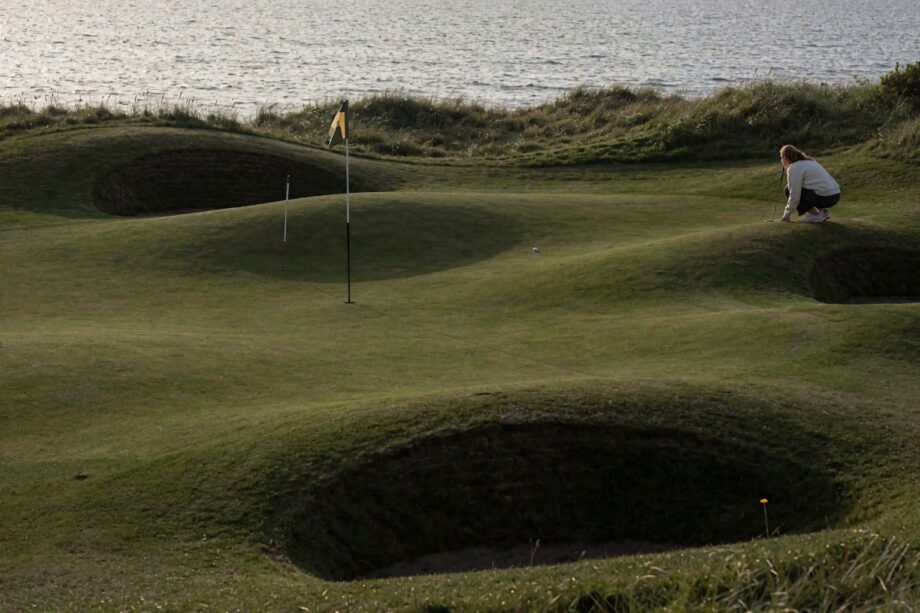
What the sandy ground gave those early players was a natural course. Sand drains well, so it can be played in most weather. Grazing animals, and later mowers, keep the short grass tight. The wind and the hollows made the shape. Nobody had to design the humps and hollows of a links, because the marram and the wind had already done it. The first golfers mostly had to find the best way through.
What lives in the marram grass beside a golf course?
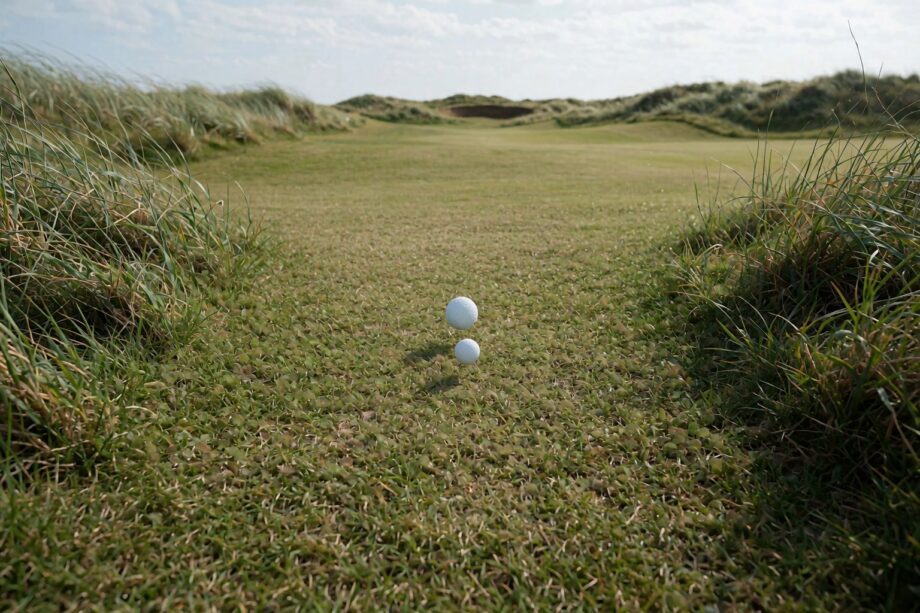
Golfers often speak about the marram side of a hole the way sailors talk about rocks. But that awkward rough is one of the richest places on the coast, and it stays rich in part because it is left alone.
Dunes hold a mix of conditions in a small space: dry, exposed sand on the crests, sheltered warm slopes, damp slacks in the hollows. Different plants and animals have settled into each. Here is a fair picture of what you might meet, depending on the coast:
- Birds. Skylarks going up over the grass and meadow pipits dropping into it are typical of open dune ground. Wheatears turn up on many coasts too.
- Rabbits. Their burrows and grazing shape the turf, and they help keep the grassland short and open, though too many can damage a dune by exposing the sand.
- Reptiles and amphibians. On a few dune systems in Britain you can find sand lizards, and the natterjack toad, which breeds in shallow, warm pools in dune slacks.
- Flowers and insects. Sea holly, restharrow, pyramidal orchid and bird’s-foot trefoil are plants of dry dune grassland. Where flowers grow, bees, butterflies and beetles follow.
We would rather tell you honestly that not every species lives on every coast than hand you a tidy list and let you assume otherwise. Dune life varies with the sand, the climate and the local history. If you want to know what lives beside a particular course, the club or the local wildlife trust is the place to ask.
One thing holds everywhere. The plants doing the quiet structural work are not the pretty ones. The marram is the foundation, and the rest of the community depends on it staying put.
Why do golf links need protecting?
Marram holds dunes together, but it is easier to break than it looks. Feet break the stems. Repeated walking along the same line wears a path, and a path in a dune is a place where the wind can start to dig. Once the covering of grass is gone, the sand begins to move, and a small bare patch can grow into a blowout, a scoop of loose sand that keeps widening.
People have understood this for a long time. Sand blowing inland has buried farmland in Scotland before now. The Culbin area on the Moray coast is the famous example, where drifting sand overwhelmed a whole estate in the 1690s. The Scottish Parliament responded around the same time with legislation aimed at stopping people pulling up the grass that held the sand down. The names and details are best checked against a proper local history, but the lesson is clear enough: the grass was worth more standing than cut.
Today the pressures are different and often quieter. Rising seas and stronger storms take from the front of the dune. Where there is a road, a car park or a clubhouse behind it, the dune has nowhere to retreat to, which is sometimes called coastal squeeze. Trampling and dog walking add to the wear. Many dune systems are recognised for their wildlife, and that recognition comes with protection.
Golf, when it is done well, can be part of the answer rather than the problem. A working links has people who care about the ground and notice when something is wrong. Greenkeepers can fence off fragile areas, plant marram to knit a damaged dune, and steer foot traffic along paths that don’t wear the same line twice. And the modern Rules of Golf make room for this. A committee can mark an area as environmentally sensitive, and when it does, players must take relief rather than play from it. It is a small rule with a decent purpose.
As a golfer, the practical part is short and unglamorous:
- Keep to the paths and the marked gaps through the dunes.
- Don’t wade into the marram to look for a ball beyond a sensible search, and never into ground marked as protected.
- Rake the sand where it is meant to be raked, and leave the dune slopes alone.
- Treat the fencing and posts as instructions, not suggestions.
Losing a ball is annoying. Losing a dune takes far longer to put right.
The scene on the plate
This is why we drew “Through the Marram” the way we did. The golfer isn’t the hero of that picture, or not the only one. The grass is. It leans and crowds the frame in the same way it crowds the edge of a real links fairway, and the golfer has to find a route through it.
We make our plates as digital artwork in the style of engraving, and we’re careful to say so. They are not antiques and not hand-engraved originals, and none of them shows a real named course. What they do is borrow the look of the old printed illustrations to point at something true: that the game grew up on this coastline, and that the coastline is still doing the work.
If you love the old game, the plate is our small nod to the plant that made the ground it is played on. It is printed to order on our T-shirts, sweatshirts and hoodies, which you can see at linksandoak.com. Next time your ball goes into the marram, take a moment before you curse it. You are standing in the oldest part of the course.
See it in the collection: The Through the Marram design