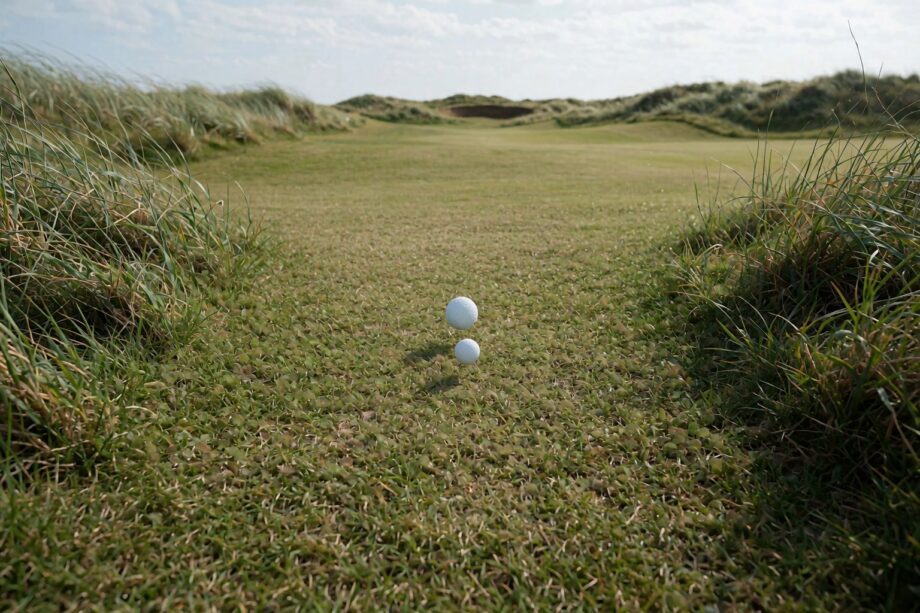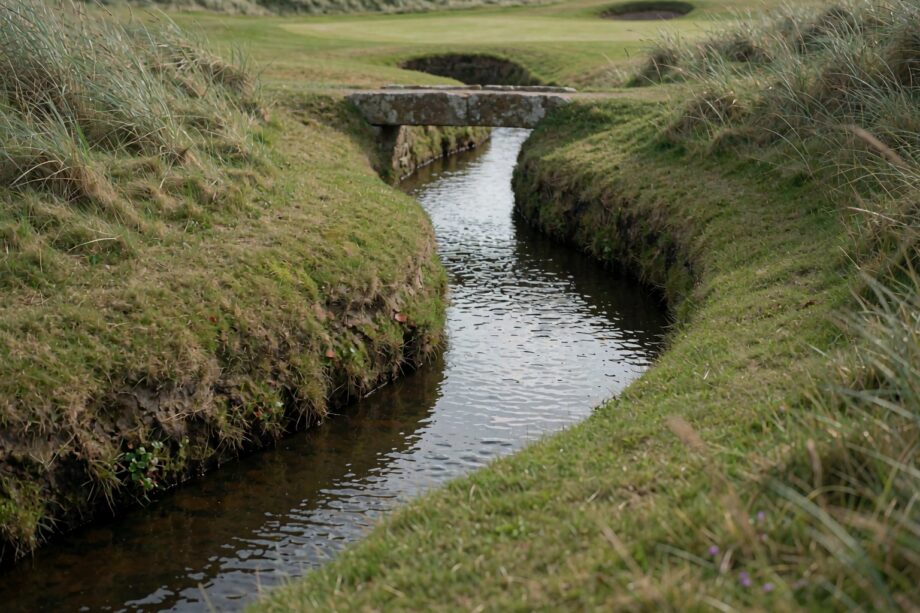
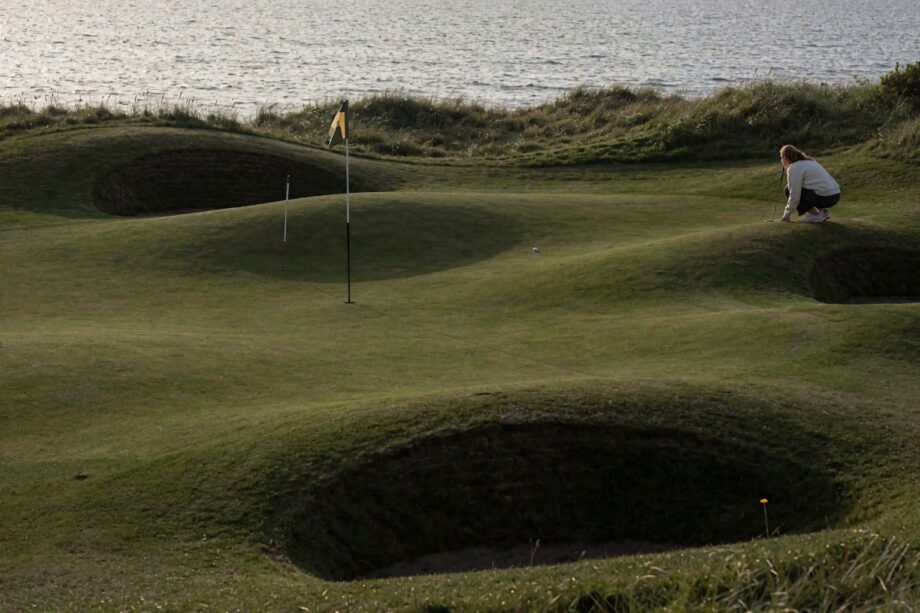
The Ladies’ Putting Club at St Andrews is a putting club founded in 1867, built around the Himalayas, an eighteen-hole putting course laid over rolling links ground near the Old Course and the sea. It gave women an organised, named place to play golf in the very town that ruled the men’s game.
We make engraving-style golf artwork, and one of our plates shows a quiet putting scene, a player bent over a line, reading the surface before she moves. It is our own artwork, drawn to look like an old engraving, and it does not show any real green. But the scene sent us looking for the real history of women putting at St Andrews, and that history is well worth telling properly.
What happened at the Ladies’ Putting Club in 1867?
The Ladies’ Putting Club at St Andrews dates itself to 1867. That is the founding year the club itself gives, and it is the year most accounts of the town’s golf repeat. We have relied on that date as the club’s own, rather than as something we have worked out independently, and if you are quoting it in print it is worth checking against the club’s current material.
What makes the date interesting is the setting. St Andrews was already the centre of the golfing world by then, but the Old Course was very much a man’s arena. The Royal and Ancient Golf Club governed the game from the town, and its members were men. Women were not part of that world as members, and the long courses were not designed with them in mind.
A putting club solved a practical problem. Putting needs no great swing, no heavy carry and no long walk out over rough ground. It needs a good surface, a putter and company. In a period when a woman in full Victorian dress could not swing a club freely, a putting green was a place where she could play a real game of golf on equal terms with anyone else standing on it, and play it well.
We should be honest about the limits of what we know. We have not seen the founding minutes, and we are not going to invent the names of the first members, the number who joined or the words they spoke. What survives in the general record is the year, the purpose and the place. That is enough to build on, and we would rather stop there than dress it up.
What is the Himalayas putting green at St Andrews?
The green itself is known as the Himalayas. It lies on the links land at St Andrews, close to the Old Course and the sea, and it is not a single flat carpet with a hole in the middle. It is a full putting course of eighteen holes laid over rolling ground, with humps, hollows and slopes that make a straight putt a rarity.
The name is a joke, and a good one. Nobody is climbing anything on those slopes, but a ball rolling across them behaves as if it has somewhere to be, and the ridges are large enough, in a putter’s eye, to deserve a mountain range. That sort of affectionate exaggeration is very much in the spirit of golf’s own language.
It is also a lesson in reading a green, which brings us back to the plate. A ball on the Himalayas does not simply go where it is aimed. It answers to the slope under it, to the grain of the grass and to how firmly it is struck. The skill is in looking before you putt. Where the ball will start, where it will slow, where it will turn: all of that is decided in the seconds of study before the stroke. Golfers call it reading the green, and it is as old as the game.
The Himalayas has also, over the years, become something wider than a women’s preserve. It is now widely known as a course anyone can play, and visitors to St Andrews go there for a relaxed round after or instead of a day on the big courses. The Ladies’ Putting Club still exists alongside it. We would point you to the club’s own pages for how the two fit together today, since arrangements like that change and we do not want to state as current something we have not confirmed this week.
Did the Ladies’ Putting Club start women’s golf?
It is tempting to say the Ladies’ Putting Club started women’s golf. It did not, and it would be wrong to claim so.
Women were playing golf in Scotland well before 1867. Accounts of the game’s early centuries include women at play, though the detail is patchy and some of the best-known stories are shakier than they look. One is the tale that Mary, Queen of Scots played golf. There is a real strand of reporting from the 1560s that she was seen playing, and it was used against her in the aftermath of her husband’s death. But how much of it can be leaned on, and how much later writers added, is a matter historians treat with care. We would call it a story attached to a famous name, and we would not build an article on it.
What the Ladies’ Putting Club represents is something more modest and more solid: an organised, named place for women’s golf in the very town that ruled the game. A club is a different thing from a scattering of players. It has a membership, a place to meet and a routine. It gives a sport somewhere to be.
The wider organisation of women’s golf came in the decades afterwards. The Ladies’ Golf Union was founded in 1893, and that same year the first British Ladies’ Amateur Championship was played at Lytham St Annes, won by Lady Margaret Scott. Those dates are secure, and they show how quickly women’s competitive golf grew once the structures existed. A putting club at St Andrews in 1867 sits early in that story, as one of the places where the habit of women playing together, seriously, was being formed.
We are careful not to say it caused what followed. History rarely works in a straight line, and we cannot show that the 1893 championship grew directly from the putting green at St Andrews. What we can say is that both belong to the same slow change: from women playing on the edges of the game to women playing in their own clubs, under their own rules, in their own championships.
Putting is also worth a word on its own account. It is the part of golf where strength counts for least and judgement counts for most. Every player, whatever their driving distance, faces the same ninety seconds of doubt over a three-footer. The Himalayas, with its slopes and its cheerful name, makes that equality plain. Perhaps that is part of why it has lasted.
Where the plate fits
We draw our plates as digital engraving-style artwork. They are not antiques, not hand-engraved originals and not pictures of a named course. The putting scene on our plate is an invention in an old style, made to catch a feeling: the stillness before a stroke, the patience of reading a line, the long tradition of people bending over a green and thinking hard about a small white ball.
That feeling is what the real Himalayas holds too. It is a green where the slope is the whole point, and where the person putting has to slow down and look. We think that is worth putting on a garment, and worth knowing the history behind.
If you love the old game, and especially the quiet corners of it, you can see the plate on our site, printed to order on our T-shirts, sweatshirts and hoodies.
See it in the collection: The Read the Green design