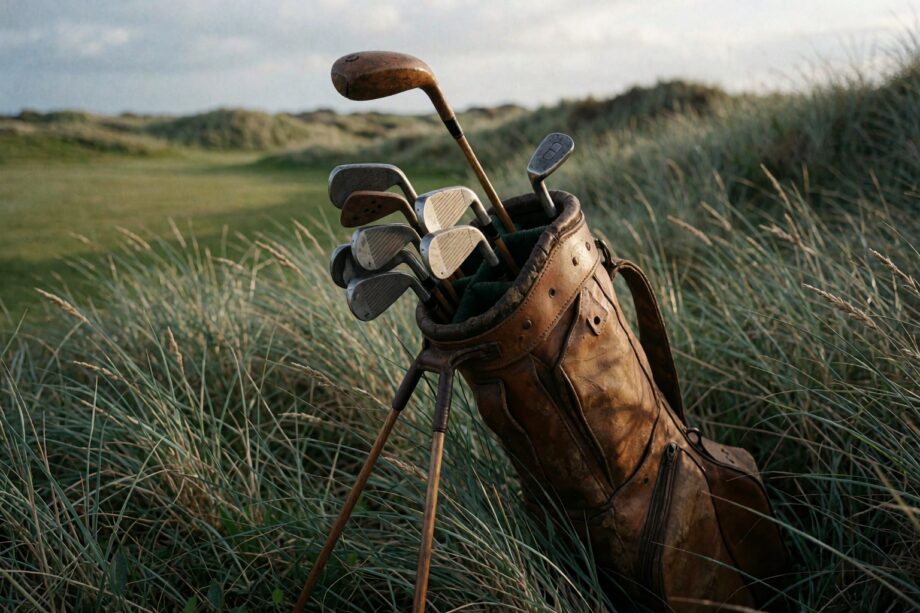
A cleek, mashie and niblick are old names stamped on hickory-shafted golf clubs from before clubs were numbered. As rough modern equivalents, a cleek sits close to a one or two iron, a mashie to a five iron, and a niblick to a nine iron or wedge, though none of these are exact matches, since the old names were never built to a fixed standard.
At Links & Oak we are fond of the old game and its vocabulary, so this is the long version of the story behind one of our plates, the one that gathers these club names together. The plate is digital artwork in the style of an engraving. It is not an antique and it is not a hand-engraved original, and it does not show any real named course. What it does show is a scene of clubs, and the clubs have real history behind them.
Why the clubs had names at all
For a long stretch of golf’s history there was no such thing as a matched set. Clubs were made one at a time by individual makers, often by hand, with hickory shafts and heads of wood or forged iron. Each club was built to do a particular job, and a golfer picked up a few of them over the years, from different makers, each with its own feel. Names were the natural way to talk about them. Nobody was going to say “my number four” when there was no number four to refer to.
Numbers arrived later. They came with the move to steel shafts and with the idea of a set made together, with even steps of loft and length from one club to the next. That was largely a development of the 1920s and 1930s. Before it, the names were the system, and they were looser than any numbering scheme. Two golfers might swap clubs and disagree about what one of them ought to be called.
That looseness is the reason the old names do not convert cleanly. A modern seven iron is one of a family built to sit at a precise distance from its neighbours. A mashie-niblick was simply a club that sat somewhere between a mashie and a niblick, in the hands of a particular maker, and the maker’s idea of “between” was their own.
What is a brassie, spoon and baffy?
Start with the woods, because their names are the ones that survived longest. The driver was the club for the tee shot, and the word is still with us. The brassie was a wooden club with a brass plate screwed to the sole, which protected the wood when it met hard ground. It was lofted a little more than a driver and used off the fairway, and it is generally treated as the ancestor of what we now call a two wood.
The spoon was the next step up in loft. The name is usually explained by the shape of its face, which was slightly hollowed, or “spooned”, and it was a club for getting the ball into the air from the fairway when a driver would not do. Old makers turned out long spoons, middle spoons and short spoons, which tells you these were a range of clubs and not a single fixed one. The spoon is commonly lined up with a modern three wood.
Then there was the baffy. It was a short-shafted, well-lofted wooden club, made for playing the ball up and onto the green from a fairly short distance, often from a poor lie. The word is usually linked to an old Scots verb, “to baff”, meaning to strike the ground with a club, and that fits the way the club was used, taking the ball with a bit of turf. It is sometimes matched to a four or five wood, but it was a shorter, more delicate tool than that comparison suggests, and it faded out of use fairly early once iron clubs took over the short game.
If you take one thing from the woods, take this: brassie, spoon and baffy describe a ladder of loft, but the rungs were never evenly spaced.
What is a cleek, mashie and niblick?
The cleek is the one I find most appealing, mainly because of the word. “Cleek” is Scots for a hook, and the golf club took the name. It was an iron-headed club with a fairly straight face, the long-distance iron of its day, used to hit the ball a good way without much loft. People often set it beside a one or two iron. Cleeks came in several sorts: a driving cleek for distance, and shorter, more lofted ones for shots to the green. There was even a putting cleek. So the word describes a family, not a single club.
The mashie sits in the middle of the bag. It had a shorter shaft than a cleek and more loft, and it was the club for a controlled approach to the green. The usual rule of thumb is that a mashie is roughly a five iron, and as a rule of thumb it is not bad. Where the name comes from is less certain. One suggestion is a link to the French word for a club, but I would not put that forward as settled, because the origins of these names are honestly murky. What we can say is that the club was popular, and that it became the everyday workhorse for a good many players.
Between the mashie and the niblick came the mashie-niblick, which is exactly what it sounds like: a compromise, with more loft than a mashie and less than a niblick. It is usually compared to a seven iron. It is a good example of why the names resist a tidy conversion, since it was named for its neighbours and not for a number.
The niblick was the club with the most loft and the shortest reach. It was made for trouble: deep rough, awkward lies, and the bunkers, where the ball had to be lifted out steeply. It is generally compared to a nine iron or a modern wedge. The name is another whose origin is not firmly known, so I will not pretend otherwise.
There were other names in the bag as well. The jigger was a short-shafted iron with a fairly straight face, often used for running the ball up to the green from just short of it, and it is often described as similar to a mid iron. The mid-iron and the lofter had their places too. The bag was a mix, and every golfer’s mix was a little different.
Why don’t old club names match modern clubs exactly?
Here is the honest summary. A table of equivalents can be useful as a guide, and most people who write about old clubs offer one, but it should be read as an approximation.
- The old clubs were made by different makers, so the same name could mean different lofts and lengths from bag to bag.
- Hickory shafts flex differently from steel, so even a matching loft on paper does not play the same way.
- The balls were different. The gutta-percha ball, which arrived in the middle of the nineteenth century, and the rubber-core ball that followed around the turn of the twentieth, each behaved differently from a modern ball, and clubs were shaped around what the ball would do.
- Modern sets are designed as a series. The old bag was assembled, not designed as a whole.
That last point matters most. A numbered set is a piece of engineering with even gaps. An old bag was a collection of tools that a golfer had come to trust, and its logic was personal.
There is one more thing that changed the shape of the bag. In the late 1930s the governing bodies limited golfers to fourteen clubs. Before that, a player could carry as many as they liked, and some did, which is part of the reason so many names were in circulation. The limit pushed the game toward tidy, numbered sets, and the old vocabulary began to slide out of everyday use.
Sand shots offer a nice last example of how the bag kept changing. The sand wedge, as we know it, is commonly credited to Gene Sarazen in the early 1930s, who built one with a heavier, flanged sole to help the club bounce through sand instead of digging in. Whatever the full story, the niblick’s old job in the bunker was being handed to something new, and the name went with it.
What to do with all this
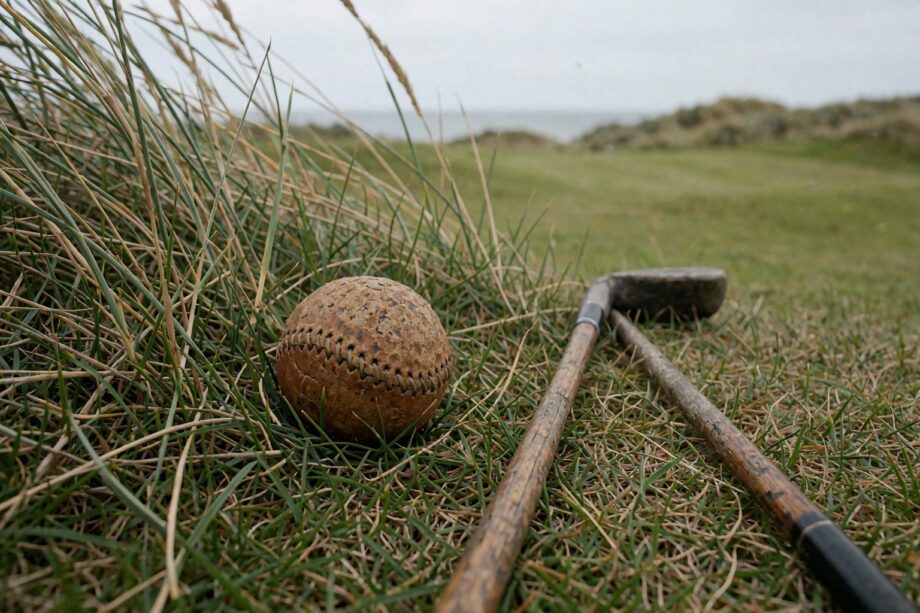
If you come across a set of hickory-shafted clubs, look for the name stamped on the head, and take it as a clue to the club’s intended job and not as a precise specification. Compare the loft with your own irons if you are curious, and you will probably find it close to a modern club but not identical. That gap is the charm of the thing.
And if you have never held one, the names alone are worth learning. Cleek, mashie, niblick, spoon and baffy are a small piece of the language of the game, and they tell you that golf was once a craft of individual tools and individual judgement.
That is the spirit behind our plate, “Cleek Mashie Niblick”. It gathers those names in a scene drawn in an engraving style, as a piece of digital artwork made for people who like the old vocabulary of the game. You can see the design on the Links & Oak site, printed to order on T-shirts, sweatshirts and hoodies.
See it in the collection: The Cleek Mashie Niblick design