The bump and run is a golf shot played low along the ground instead of high through the air: you land the ball a short way onto the turf and let the ground carry it the rest of the way to the hole. It is one of the oldest ideas in the game, born on the firm, sandy links land of Scotland, where wind and tight turf make a low, running ball far more reliable than a high, soft one.
We draw a scene like this on one of our plates, and here is the real story behind it, with the parts we can stand behind and a few honest notes about the parts nobody can prove.
What is a bump and run shot in golf?
The idea is simple. Instead of lofting the ball high and landing it softly beside the hole, you strike it low, land it a short way onto the turf, and let it roll the rest of the distance. The ground carries the ball, not the air.
The name is worth a word. “Bump and run” is the phrase you hear most often today, and it is common in American golf writing. Older British talk tends towards the running approach, the run-up, or the chip and run. They are close cousins rather than a single exact shot, and golfers argue about where one ends and the next begins. What they share is a low flight and a long roll.
Think of it like skimming a stone rather than lobbing one. You are not fighting the surface, you are using it. A high, soft shot needs the ground to stop the ball. A running shot needs the ground to move it, and on the right kind of ground that is far more dependable.
Why do links courses call for a bump and run?
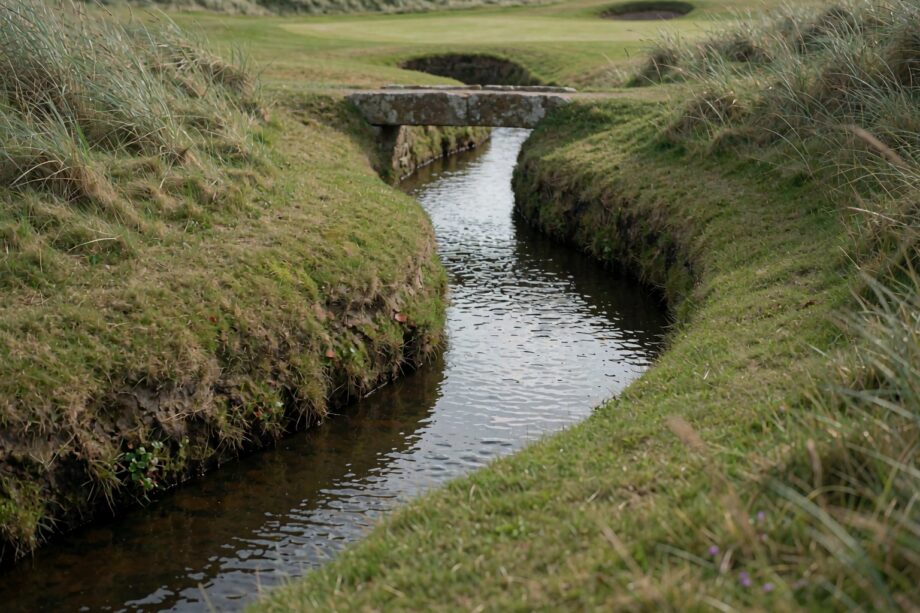
The word “links” comes from an old Scots and English word for rising, uneven ground, and it came to mean the strip of sandy, grassy land that lies between the sea and the farmland behind it. That land is the reason for the shot.
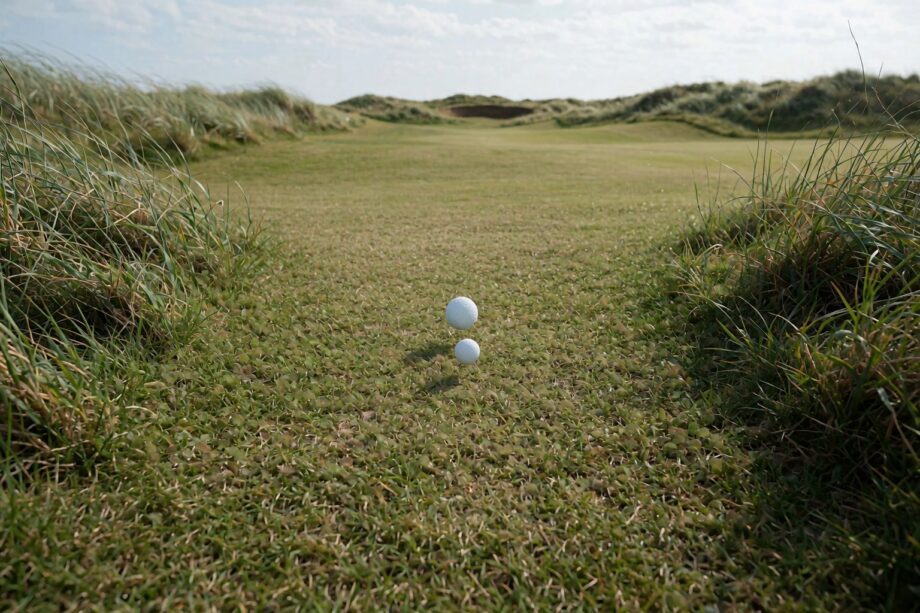
Sandy soil drains quickly. Turf on it stays firm and tight, and the grasses that grow there are fine and wiry. A ball landing on it does not sink in and stop. It bounces and runs. The land is also rolled into humps and hollows, so the ground in front of a green is rarely flat, and it is often open at the front, with no bunker or bank forcing you to carry the ball in the air.
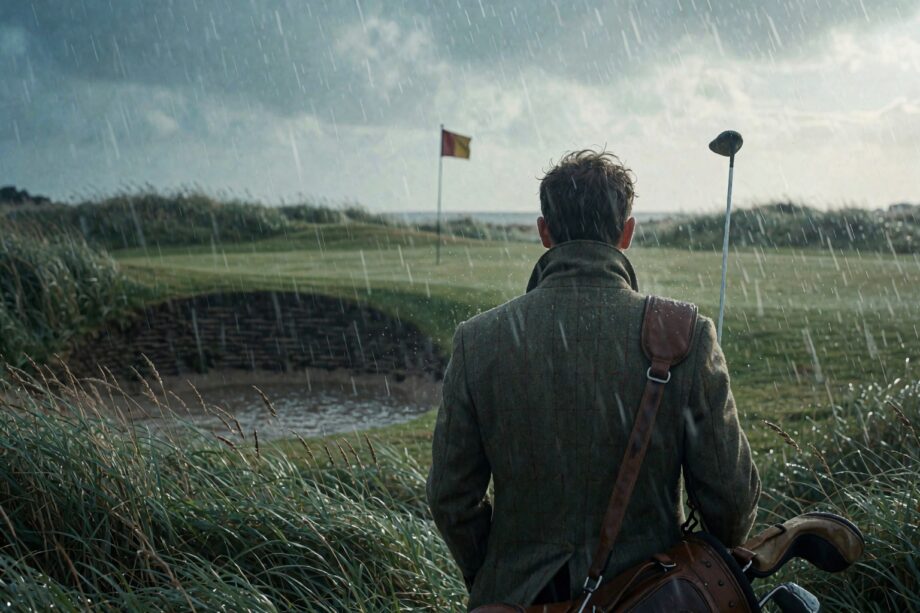
Then there is the wind, which is a large part of the story. Anyone who has stood on a coastal course on a blustery day knows what a high ball does: it climbs, hangs, and drifts. A low ball stays under the worst of it. Keeping the ball down is not stubbornness. It is the sensible answer to the weather that comes off the sea.
Put firm ground and steady wind together, and the low running shot stops being a trick and becomes plain good sense. That is why links golfers talk about “playing the ground” as much as playing the ball.
Where did the bump and run come from?
Nobody invented the bump and run in the way someone invented a new club. There is no named person and no date to point to, and we will not make one up. What we can say is that the game as it was first played almost demanded it.
Golf on the Scottish coast is documented as far back as the fifteenth century. An Act of the Scottish Parliament in 1457 told people to give up golf and football and practise archery instead, which tells us the game was popular enough to be a nuisance to the authorities. We do not know exactly how those early players struck the ball, but we know the ground they played on: open, sandy, windswept coastal land.
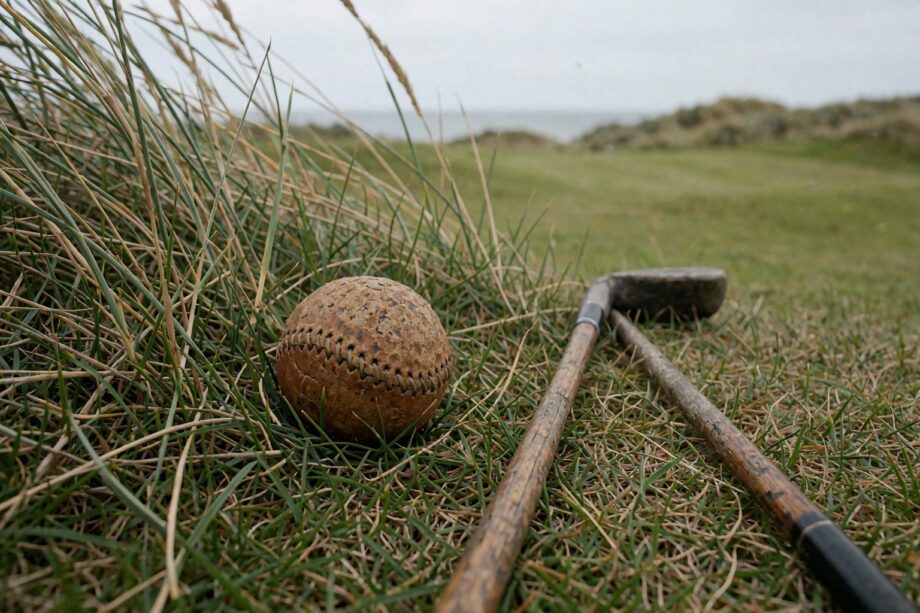
The equipment then helped shape the method. For centuries the ball was the “featherie”, leather stitched around a stuffed lining of feathers. It was costly to make and could be damaged in wet conditions. In the middle of the nineteenth century it was replaced by the gutta-percha ball, a solid ball moulded from the dried sap of a tropical tree, which was cheaper and tougher. Neither ball rewarded a high, stopping shot. Clubs were wooden-shafted, and golfers carried a small number of them with names such as the spoon, the baffing spoon and, later, the mashie and niblick. Those names come down to us from the period, and lofted clubs did exist, so high shots were possible. But the ball, the shafts and the turf all pointed in one direction: get it low, get it rolling, and let the ground finish the job.
The written rules of the game tell a similar story. The first known set of rules, thirteen of them, was drawn up in 1744 for a competition at Leith by the Gentlemen Golfers of Edinburgh, who later became the Honourable Company of Edinburgh Golfers. Those rules describe a game played over rough natural ground, where you played the ball as you found it. A course that was mostly nature meant a player had to work with whatever the land gave, and the land gave slopes and firm turf.
A myth is worth naming here. You will sometimes read that sheep and rabbits made the first hazards and paths on the links, and that golfers simply followed what the animals had shaped. It is a charming story and it gets repeated a great deal, but we have not seen it pinned to a firm source, so we treat it as a nice piece of golf folklore rather than history.
What changed, and why the shot survived
Around the turn of the twentieth century the Haskell ball arrived. It was wound with rubber thread around a core and it behaved very differently: it flew farther, and it could be made to spin and stop. Over the following decades, steel shafts and lofted wedges made a high, soft landing much easier to produce. Watering systems and inland courses with softer turf made stopping the ball a safer bet in many places. Golf, for a great many players, became a game of carrying the ball to the flag.
Yet the low running shot never went away, and the reason is worth remembering. It never depended on the equipment alone. It depended on the ground. Where the turf is firm and the wind is up, a high pitch is a gamble and a running shot is a percentage play. A wedge can make a ball fly, but it cannot make the wind behave or the ground softer.
There is also a quiet skill in it. The bump and run is often called the simplest shot in golf, because the stroke is small and the motion is close to a putt. It is also one of the hardest to judge, because you must read the ground: the slope, the pace of the turf, the hump that will kick the ball left. Golfers who grew up on links tend to talk about this with a certain pride. The shot takes imagination as much as technique, and it rewards patience and a feel for the land.
Reading the scene on the plate
This is the scene we wanted to draw. A golfer, a low ball, and an open stretch of firm ground between the two of them and the flag. There is no big swing, no drama in the air. The action is all along the turf, and the picture asks you to follow the ball with your eyes rather than up into the sky.
We should be plain about what our plate is. It is digital artwork in the style of an engraving. It is not an antique, it is not hand-engraved, and it does not show any real named course. It is our own drawing of a way of playing that is very old, made to look like the sort of print you might find framed in a clubhouse corridor.
If the bump and run is a shot you love, or one you have always wanted to understand, the plate that shows it is on our site, printed on our shirts, sweatshirts and hoodies. Have a look, and next time you are short of the green with a stiff breeze in your face, try aiming at the ground in front of you instead of the flag. The old golfers would have understood.
See it in the collection: The The Ground Game design