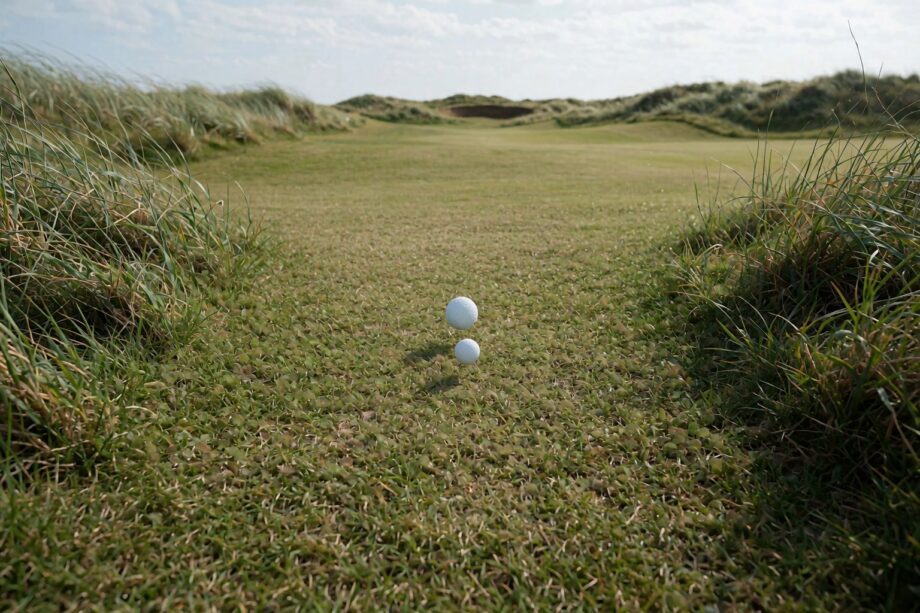
What did golfers play with before the gutty?
Ask most people what a golf ball is made of and they will say rubber, or plastic, or something with a fancy name on the box. For the first few centuries of the game in Scotland, the answer was far stranger: feathers.
The ball of that era is known as the featherie. A maker stitched together a leather casing, packed it with a top hat’s worth of boiled feathers, and sewed it shut. As the feathers dried they expanded and the leather shrank, which left a hard little ball that flew well when it was struck cleanly. It was also slow to make and dear to buy. It did not enjoy rain either. A wet featherie could split, and a hard hit with an iron could open a seam. Players lost them in whins and burns, and each loss stung.
That was the problem waiting for a solution. Golf was a game for people who could afford to keep replacing its most fragile part. It is hard to picture a sport spreading widely while its ball behaved like that.
Where did gutta-percha come from?
The answer sits a long way from the Scottish links. Gutta-percha is the dried latex of trees found in South East Asia, and it had long been known to people in the region who shaped it into handles and other useful objects. Europeans began to take proper notice in the 1840s, when samples reached Britain and the material’s odd character became known. It turns soft and workable in hot water, then hardens again as it cools, and it can be softened and shaped a second time.
That last quality mattered enormously. It was not only golf that noticed. Gutta-percha became prized as an insulator, and it went on to coat undersea telegraph cables. Golf simply got there early and found its own use for the stuff, one that had nothing to do with wires.
The story of how it reached the golf course is told in several versions, and it is worth being straight about that. The version you will meet most often names a St Andrews man, Robert Adams Paterson, and puts the first gutta-percha ball at about 1848. The tale usually runs that a packing of gutta-percha arrived around some goods, and that someone thought to warm the material and roll it into a ball. Historians of the game generally treat that account as the best-known tradition rather than something every detail of which can be pinned down. What is not in doubt is the period. By the end of the 1840s the gutta-percha ball existed, and by the early 1850s it had taken over Scottish golf. We should say “about 1848” and mean it as “about”.
The ball soon had a nickname. Golfers called it the gutty, and the name stuck for as long as the ball lasted.
How was a gutty made?
This is the scene at the heart of our plate, so it is worth going slowly.
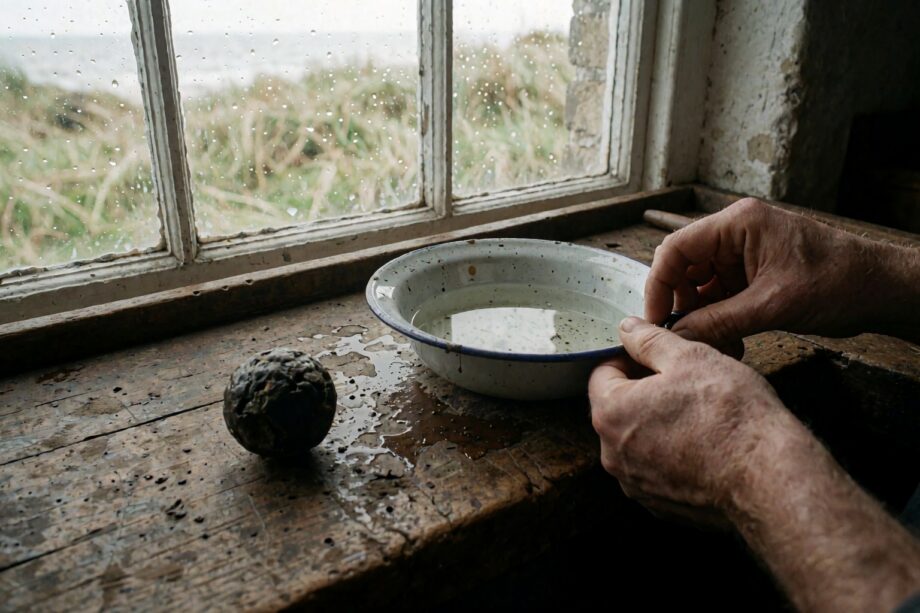
The raw material came in as a hard, dark, leathery stuff. The maker put it in hot water until it went soft and pliable, then worked a piece between the palms into a rough ball. Early gutties were made just like that, rolled by hand. The ball was then left to cool and harden, and it could be dipped in cold water to speed things up.
Hand rolling worked, but it was slow and the balls varied. Makers soon turned to metal moulds, in which a warmed piece of gutta-percha was pressed between two halves, so that each ball came out rounder and more consistent. The heat-and-mould method is what turned the gutty from a curiosity into a product. Because the material could be softened again, a scarred or lopsided ball did not have to be thrown away. It could go back in the water and be remade. Compare that with a featherie, which once split was finished.
A gutty was also tougher and cheaper than a featherie, and it stood up to wet weather. Those three advantages explain why golfers took it up so quickly, even though many of the old hands did not like it at first. Some of the early stories are of makers and players who felt it had spoiled a craft, and there are tales of resentment between the featherie trade and the new ball. Some of those tales are told with more colour than the surviving record can back, so treat the neatest ones with caution. The fair reading is simple enough: a craft that made expensive balls one at a time was shaken by a ball that could be produced in numbers.
Why does a nicked ball fly better than a smooth one?
Here is the part of the story that we find most satisfying, because it is a case of golfers learning from what they saw.
A new gutty was smooth, and a smooth ball did not fly especially well. Players noticed, over time, that a ball that had been played for a while and scuffed and cut by iron clubs seemed to go further and hold a straighter line than a fresh one. That was not a trick of the eye. The marks changed how the ball moved through the air.
Modern aerodynamics explains it. A smooth sphere pulls a broad wake of turbulent air behind it, which drags on the ball. Roughness on the surface disturbs the thin layer of air clinging to the ball so that it stays attached longer, and the wake gets smaller. Less drag means more distance. Surface marks, together with backspin, also help the ball generate lift and stay in the air. The players of the 1850s had none of this vocabulary. What they had was a ball in the hand and a fair idea of which ones flew.
So they acted on it. Golfers and ball makers began to mark the surface on purpose, and the usual tool was a hammer with a sharp edge, used to pepper a new ball with nicks and cuts before it was played. It was a job done by hand, ball by ball, and a well-hammered gutty was a mark of care. In time the marking moved into the moulds, and gutties came out of the press already patterned. A number of patterns appeared. One that gave its name to an entire type was the bramble, whose raised bumps look like the fruit. You will still hear “bramble” when people talk about old balls.
It is a lovely little piece of trial and error. Nobody sat down with a wind tunnel. A generation of golfers kept playing, kept looking at what was left of their balls, and worked it out. The dimples on a modern ball are a far more refined descendant of that same idea.
What did the gutty change about the game?
Once the ball became cheaper and tougher, more people could afford to play, and more people could lose one without it being a small disaster. It is reasonable to link the rise of the gutty to the growth of golf through the second half of the nineteenth century, when the game spread beyond its Scottish heartland and new courses appeared. We would not want to claim the ball did all of that on its own. Railways, growing leisure time and a fashion for the game all played a part. But a ball that lasted was a good foundation to build a boom on.
The gutty also changed how clubs were made and used. It was a harder ball than the featherie, and the wooden clubs of the featherie era, with their slender heads, were more likely to be damaged by it. Makers adapted, and club design moved on. Iron clubs also found more work, because a hard ball responded to them well. That is the sort of knock-on effect that is easy to state loosely, so we will keep it loose: the gutty and the clubs developed together.
The gutty’s reign was long, but it was not permanent. At the end of the 1890s an American, Coburn Haskell, working with Bertram Work of the Goodrich company in Akron, Ohio, developed a ball made of rubber thread wound under a covering, and it was patented in 1899. The wound ball flew further and felt livelier, and within a few years the gutty was on its way out. Professionals and amateurs both moved across. The ball that had taken over the game in the 1850s gave way to a new one within roughly fifty years.
Fifty years is not long, given how completely the gutty had shaped golf. Its rise and fall is one of the more tidy chapters in the sport’s story: a new material, a cheaper ball, a happy accident of scuffing, and then a better idea from across the Atlantic.
Where our plate comes in
We wanted to make the gutty one of our plates because the scene has so much in it. The softened lump, the mould, the hammer and the row of finished balls all belong to a single craft moment. Nothing about it is polished. It is work.
A quick word on what our plates are. They are our own digital artwork, drawn in the style of an old engraving. They are not antiques, they are not hand-engraved originals, and the scene does not show any real named course. We say so plainly because we would rather you enjoyed the artwork for what it is than believed something about it that is not true. The history in this article, on the other hand, is real, and we have kept to what the record supports and marked the places where the old tales go beyond it.
If the story of the gutty appeals to you, the “Gutta Percha” plate is our way of putting it on something you can wear. You will find it on our site, printed to order in the UK or USA on T-shirts, sweatshirts and hoodies. It is for anyone who has ever looked at a scuffed old ball and wondered how such a rough little thing changed a whole sport.
See it in the collection: The Gutta Percha design