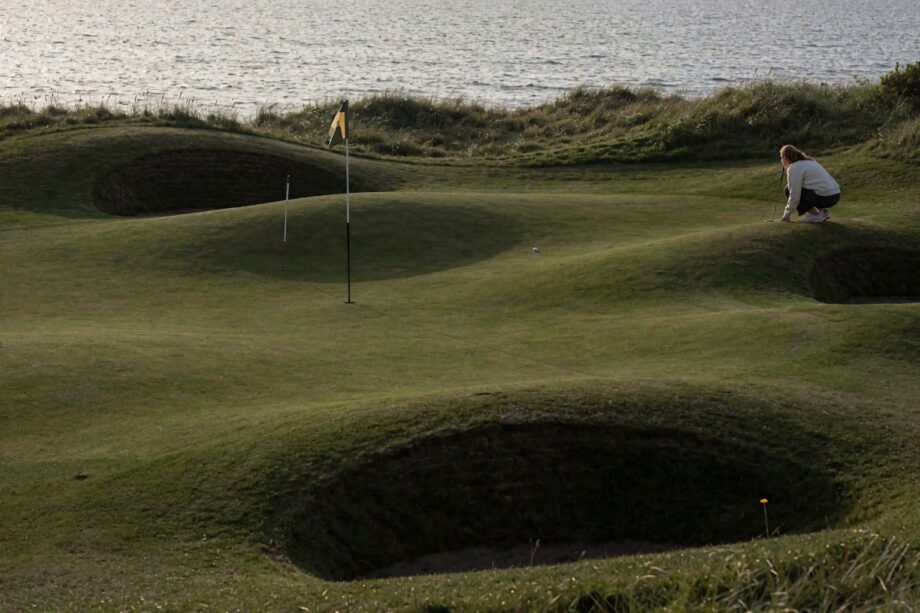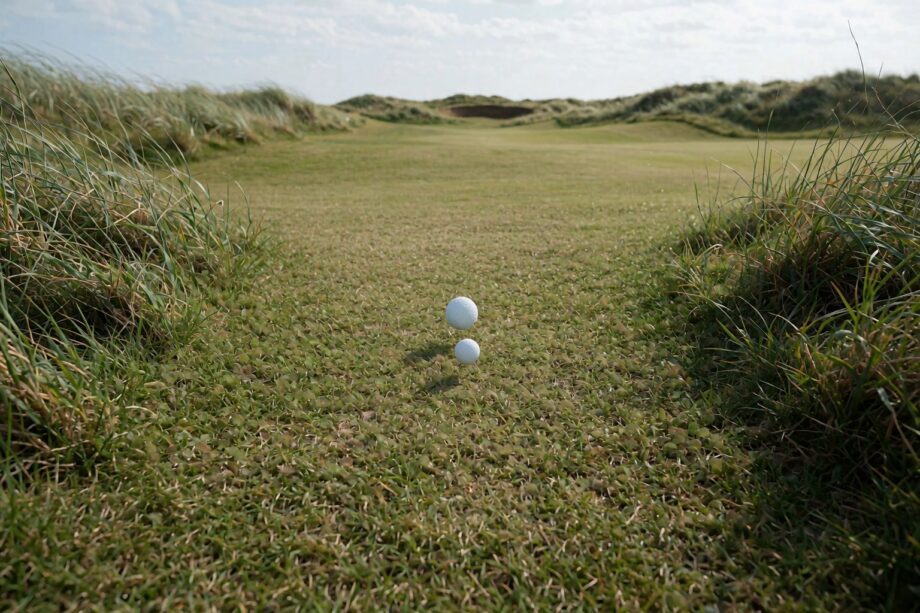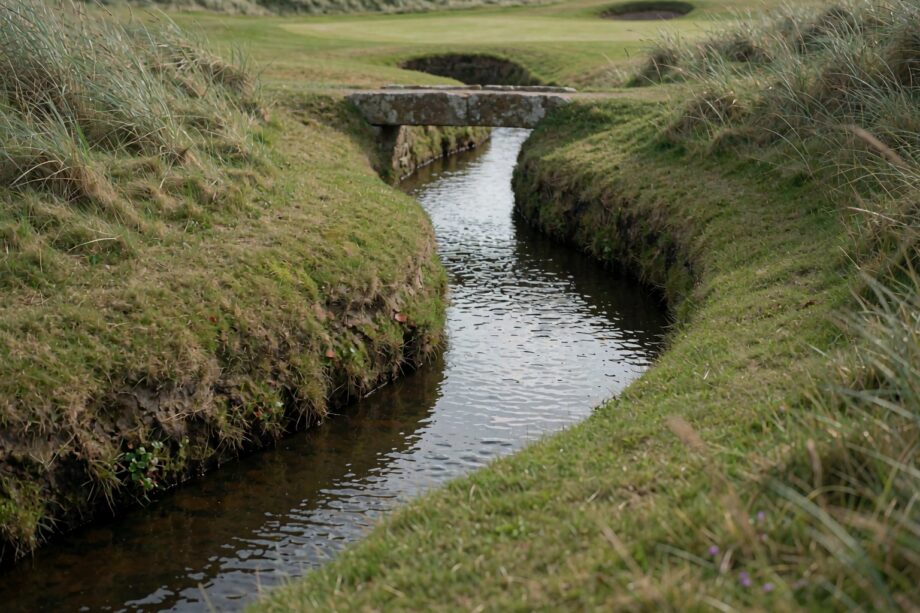

The old links belonged to everyone because for most of golf’s history nobody owned the ground outright. It was common land: townspeople grazed sheep on it, cut turf from it and dried their washing on its short grass long before anyone thought of it as a golf course, and because the sandy, wind-shaped ground between sea and farmland was too poor for crops, it stayed open to all, which is why golf was already popular enough among ordinary people to worry the Scottish Parliament into banning it in 1457.
We make engraving-style artwork, and we like to know what stands behind a scene before we put it on a shirt. So here is what we found, what we could support, and what we left out because nobody can prove it.
Why was links land never farmed or fenced?
Start with the word itself. “Links” comes from the old Scots and English word for rising or rough ground, and it came to mean the strip of sandy, grassy land that lies between the sea and the farmland behind. That land is thin soil over sand. It drains fast, it is shaped by wind, and it is very poor for crops.
Poor for crops does not mean useless. A town on the coast could put sheep on it, cut turf from it, keep rabbits on it, and spread its washing over the short grass to dry. Because nobody could make a good farm of it, nobody fenced it into private fields, and it stayed open. Custom did the rest. The townspeople used it, their parents had used it, and that habit hardened into something close to a right.
Golf grew up on exactly this kind of ground, and there is a plain reason for it. The turf was already kept short by grazing animals and rabbits. The dunes and hollows gave you natural hazards without anyone digging a thing. And the land was open to whoever wanted to walk out and play. Nobody built the first golf courses in the way we would say it now. Players found ground that was already suited to the game and, in a sense, borrowed it from everyone else who used it.
That is why the old picture of a links is so mixed. A golfer, a shepherd, someone drying linen and a child chasing a dog could all be on the same stretch of ground on the same afternoon, and none of them was trespassing.
Was golf always played on public ground?
We should be careful here, because early golf history is full of stories that are told with more confidence than the evidence allows. What we can point to is this. In 1457 the Scottish Parliament, under James II, ordered that “futeball and golfe” be stopped, because men were playing them when they should have been practising archery for the defence of the realm. Similar orders followed later in the century. Whatever else that tells us, it tells us golf was popular enough among ordinary people to worry a government. It was not a private pleasure of a few gentlemen. It was a public habit on public ground.
The link to a particular place is where we slow down. St Andrews is the best documented case. A charter of 1552, issued by Archbishop John Hamilton, confirmed the right of the people of the town to use the links for recreation, and golf is named among the pastimes. The same document reserved the right to keep rabbits for the archbishop. So even in the sixteenth century the ground was being shared between different interests, each with its own claim, and somebody had bothered to write the arrangement down.
That arrangement did not stay peaceful forever. Rabbits and golf do not mix well, and over the centuries the ownership of parts of the links passed through different hands, with argument over what the town could and could not do on it. We are not going to try to summarise every dispute, because the details are tangled and we would rather leave them out than get them wrong. The useful point is that the townspeople’s use of the ground was strong enough that, in the end, the law backed it. The St Andrews Links Act of 1894 put the management of the links in the hands of the town, to be kept for public recreation. Golf on that ground stayed open to the public, and the townspeople’s older uses were protected alongside it.
There is a habit at St Andrews that still reflects that thinking. The Old Course is traditionally closed to golfers on Sundays, which leaves the ground for walkers and for the town. We would call that a living echo of the old idea: the links is a golf course, but it is also the town’s open ground, and the town gets it back one day a week.
Where were the first written rules of golf drawn up?
Leith, on the edge of Edinburgh, is another place where the common ground and the game overlapped. Leith Links was open land used by the townspeople, and golf was played there for a long time. In 1744 a group of players there, the Gentlemen Golfers of Leith, drew up a set of thirteen rules for a competition for a silver club. Those rules are usually described as the earliest known written rules of golf. It is worth noticing where they were written: not for a private estate, but for a public links that plenty of other people were also using.
You will read in various places that a particular course is the oldest in the world, or that a famous monarch played on a particular green on a particular day. Several courses in Scotland make such claims, and the evidence behind each varies a great deal. We are happy to say that golf on links land goes back many centuries in Scotland and that a handful of places have strong documentary support. We are not going to say which one is “the first”, because the honest answer is that nobody can prove it, and a tidy claim is not worth a wrong one.
And the marker stones? We have to be straight with you. The stone on our plate is a feature of the picture, and we are not going to tell you it stands on any real course or marks any real boundary. Boundary and marker stones are a real part of how common land has been recorded in Britain, and links land is no exception, but we have no source for the story of one particular stone and we will not invent one. The plate shows a scene. It does not show a named place.
What is still shared today
The old idea did not vanish. It is still visible in a few places if you know where to look.
In Scotland, the Land Reform (Scotland) Act 2003 gives everyone a general right of responsible access to most land. That includes golf courses, with a very important limit: the right covers crossing them, but not walking on the playing areas of the greens and tees, and not getting in the way of play. So a path across a links is still often a public route, and the golfer and the walker are expected to make room for one another. That is a modern law, but it feels like a descendant of the old custom, and it works in the same spirit.
Down in England the same instinct shows up in a few surprising spots. On Wimbledon Common, in south west London, golf has been played alongside walkers and riders for well over a century, and golfers there are expected to wear red so that everybody else can see them coming. That arrangement comes out of the law that protects the common for the public. At Westward Ho! in Devon, the Royal North Devon course sits on Northam Burrows, an area of common grazing land, and its players share the fairways with the sheep of the people who hold grazing rights. We have not visited either to check the present rules, so if you plan a trip, please look at the current local information first. What we are confident of is the principle: on these grounds, golf is a guest as much as a host.
This is the part of golf’s story that we find most appealing. The modern idea of a course as a fenced, private, members-only estate is a fairly recent way of thinking about the game. For a very long time the ground came first and the game fitted itself around everyone else who had a claim on it. The golfer waited while a flock crossed. The townsperson walked wide of a player’s swing. The stone in the grass belonged to nobody in particular and to everybody at once.
About the plate
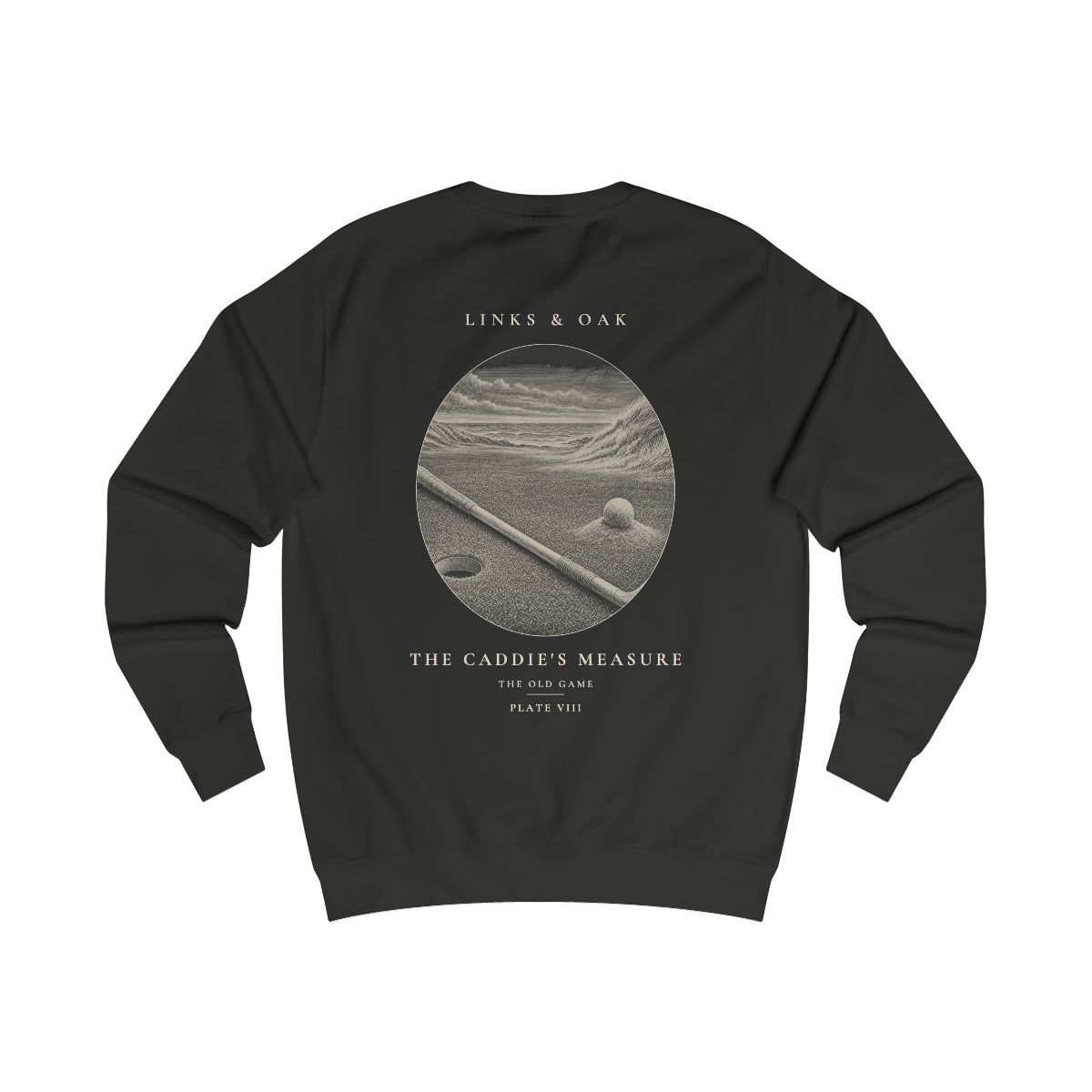
The plate that goes with this story is called “Open Ground Open Sky”, and it is our picture of exactly this idea: a wide horizon, a marker stone, and a place where the game and the public share the same grass. We want to be plain about what it is. It is digital artwork made in the style of an engraving. It is not an antique, it is not hand engraved, and it is not a historical original. The scene is ours, and it does not depict a real, named course. What it does depend on is real history: the sandy common ground of the Scottish coast, the town charters and Acts that kept it open, and the long habit of sharing it.
If you love the old game, and especially the idea that it began as something belonging to everyone, then it is a picture we hope you will enjoy wearing. You can see the design on the shirt, sweatshirt and hoodie pages below.
See it in the collection: The Open Ground Open Sky design