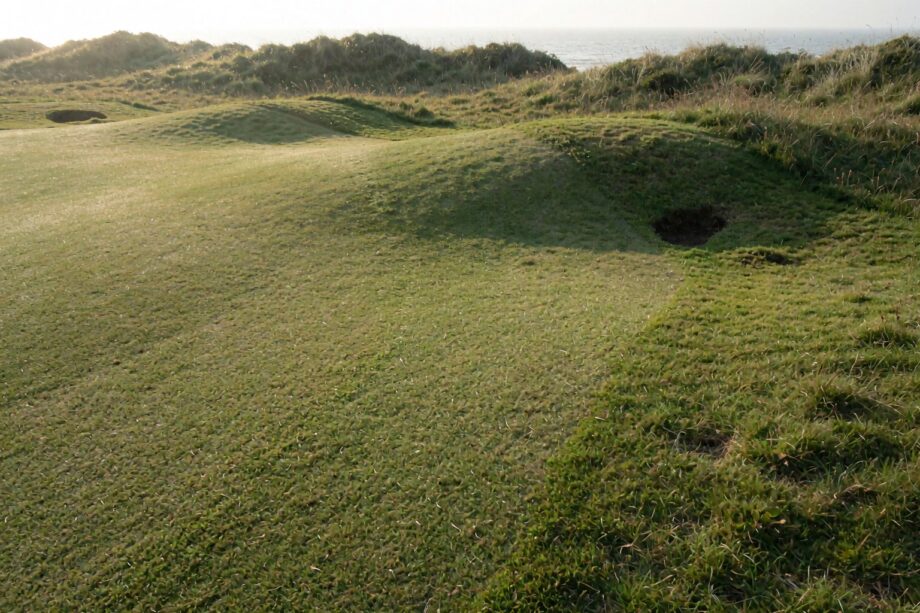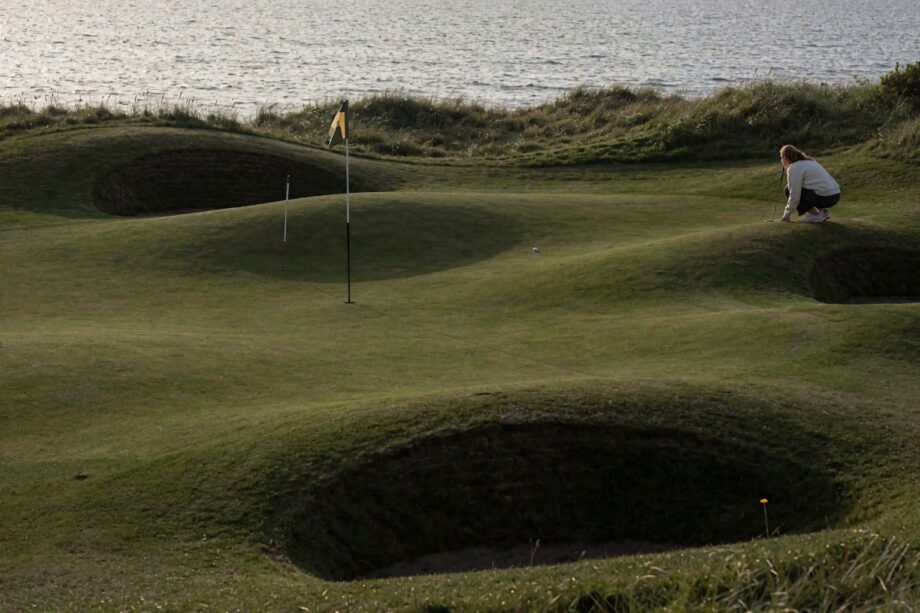

Links land is coastal ground built from sand left behind when the last ice sheets melted around ten thousand years ago, then piled into dunes by onshore wind and bound together by marram grass. Golf began there because this sandy common ground was too poor for crops, so it was left to rabbits and grazing sheep, which kept the turf short and firm while the sand drained quickly and threw up natural hollows and bunkers that nobody had to build.
It is the scene on one of our plates, “Sea Mist and Sand”, so we have spent a good while looking at it. Here is what we found.
How was links land formed?
Links land begins with sand. Around ten thousand years ago the great ice sheets that had covered much of Britain and Ireland were melting. They left behind enormous amounts of loose material: gravel, silt and sand, carried by meltwater and rivers down to the coast.
Then the sea moved. Sea levels rose as the ice melted, and in parts of Scotland the land itself was slowly rising as the weight of the ice came off it. Where those two things pulled against each other, the shoreline shifted and left broad flats of sand exposed at low tide. That is not a single tidy event. It happened at different rates in different places over thousands of years, which is one reason no two stretches of links look quite alike.
The wind did the next part. Dry sand on an open beach does not stay put. Onshore winds pick it up, carry it a short way inland and drop it wherever something slows the air. A tuft of grass, a bit of driftwood, a stone. Grains pile up around the obstacle, and a small mound begins.
Marram, fescue and the hold of the roots
What turns a moving heap of sand into a dune is planting. Marram grass is the pioneer. It copes with salt, with being buried and with almost no fresh water, and it responds to burial by growing upwards. Its roots and runners knit through the sand and hold it. The dune grows taller, and the grass grows with it.
Behind the first ridge, where the sand is a little more settled, other plants move in. Fine-leaved grasses such as fescues and bents take hold on the poor, free-draining soil. They grow low and tight, and where they are kept short they make a springy, close turf. Anyone who has walked a proper links in dry weather knows the feel of it underfoot: firm, slightly bouncy, and not at all like lush parkland grass.
This is the coastal grassland in our plate, the soft grey-green between the dunes and the sea. It is not a lawn that somebody planted. It is what grows when sand, salt wind and hungry animals decide between them what can live there.
What a blowout is
Dunes are not permanent. They are a balance, and the balance can tip. If the grass cover is broken, by heavy grazing, by feet, by a storm, or by a dry spell that kills the marram, the wind gets at the bare sand and starts to scoop it out. The result is called a blowout: a bowl or trough in the dune where the wind has taken the sand away and left the hollow behind.
Blowouts can look like damage, and in a sense they are. But they are also part of how a dune system renews itself. Sand that leaves one hollow lands somewhere else and starts a new mound. The whole landscape shifts slowly, like a very patient tide.
For early golfers this mattered enormously. A bare sandy hollow is a natural hazard. It has a lip, it has a floor of sand, and getting out takes some thought. Nobody had to dig it. Nobody had to plan it. The word “bunker” is Scots, and in the game it came to mean exactly this sort of sandy scrape. Long before anyone thought of shaping a course, the wind was supplying the hazards for nothing.
Animals played their part too. Rabbits burrow and scrape, and their activity can open up small bare patches in the turf, which the wind then enlarges. Sheep, seeking shelter from the weather, wear hollows into the lee of a dune. Some of the older hazards on old links may well owe something to that, though it is hard to pin down which ones, and we would rather say so than pretend to know.
Why did golf begin on links land?
Here we should be careful, because the beginnings of golf are honestly murky. Games played with a stick and a ball are very old, and there is a long-running argument about the influence of similar games in the Low Countries. What can be shown from written records is that a game called golf was being played in Scotland by the fifteenth century, and that it was popular enough to worry the authorities.
In 1457 the Scottish Parliament, under James II, ordered that football and golf should be “utterly cryed downe”. The concern was practical. Men were meant to be practising archery for the defence of the realm, and they were playing games instead. The ban was repeated in later acts, in 1471 and again in 1491. It plainly did not work. James IV, who signed the last of them, later took up the game himself. The royal accounts of the early sixteenth century record the purchase of golf clubs for him.
Why the coast? Think about what the land was good for. Sandy dunes and their thin, salty soil were poor for crops. They were left as common ground, used for grazing and rabbits and, it seems, for a game. The sheep and rabbits kept the turf short, which meant a ball could be found and struck cleanly. The sand drained quickly, so the ground could be played on when inland fields were a bog. The dunes gave natural rises, hollows and runs of ground, and the wind gave the game its character. Nobody needed to build a course. They walked the land, picked a place to aim at, and dug a hole.
That is why the old courses are often said to have been found rather than built. It is a fair description, as long as we remember it is a description and not a single documented rule.
The ground and the law
One thing that shows how much the links mattered is that people wrote down who could use them. In 1552 the Archbishop of St Andrews, John Hamilton, confirmed in a charter the townspeople’s right to play golf on the links there, along with other uses of the ground, including keeping rabbits. That is one of the oldest written statements we have about golf and the land it was played on. It treats the links as shared property first, and a golf course only by long habit.
Centuries later, in 1894, an Act of Parliament again dealt with the St Andrews links, protecting the town’s interest in the ground. The details of how that has worked in practice are a subject on their own, but the point stands. This was common land that people cared about long before the game had rulebooks or clubhouses.
The rulebooks did come. The oldest surviving written rules of golf are usually dated to 1744, drawn up for a competition at Leith by the Gentlemen Golfers, later the Honourable Company of Edinburgh Golfers. There were thirteen of them. Among them, if you read them closely, is a sense of the ground itself: you play the ball where it lies, and you take the land as you find it.
Does GOLF stand for ‘Gentlemen Only, Ladies Forbidden’?
You will sometimes hear that “golf” stands for “Gentlemen Only, Ladies Forbidden”. It is a neat story and there is no evidence for it. The word almost certainly comes from older Scots forms such as “gouf”, probably related to a Dutch or Germanic word for a club. Golf was played by women in Scotland from early on, and the best-known early example, Mary, Queen of Scots, is often cited, though the stories about her are a matter of tradition and later report rather than firm record. We mention the acronym only so it can be put down.
Why it still looks like this
A good deal of true links land survives on the coasts of Scotland, England, Wales and Ireland, and it is treasured for a reason. It is a rare and fragile habitat, and it is also the ground where the game learned what it was. When you stand on one on a grey morning, with sea mist lifting off the water, the low grass shaking in the wind and pale sand showing in the hollows, you are looking at something that took thousands of years to arrange itself and needed very little help.
That is what we set out to catch in “Sea Mist and Sand”. It is our own digital artwork in the engraving style, drawn as a scene and not a portrait of any real course. It is not an antique or a hand-engraved original, and we would not want anyone to think it was. What it does hold onto is that first impression of links land: sand, grass, sea and sky, with no fairway in sight.
If the story of the ground appeals to you, the plate is on the site, and there is a link to it just below.
See it in the collection: The Sea Mist and Sand design