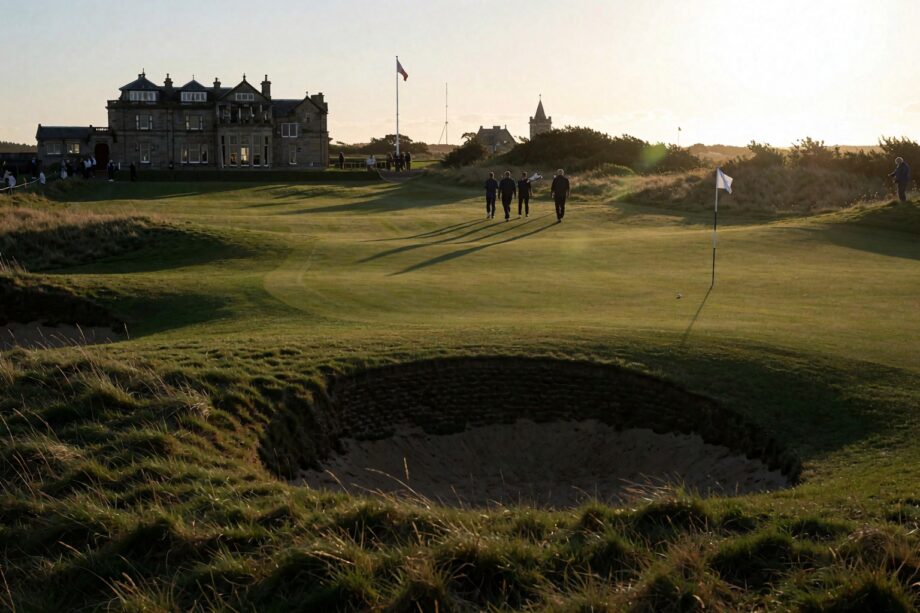
The first golf club we have real records for is the Gentlemen Golfers of Leith, formed in 1744 and later renamed the Honourable Company of Edinburgh Golfers. They are also usually credited with golf’s first purpose-built clubhouse, a golf house on Leith Links by 1768, nearly a century before the Society of St Andrews Golfers opened their own clubhouse in 1854.
We make engraving-style golf artwork, and one of our plates shows a clubhouse at the end of the day, the light going and the players heading in. It is our own digital artwork in the manner of an old engraving, not an antique print and not a picture of any real course. But the scene it shows has a real history behind it, and we wanted to tell it properly, sticking to what the records support and saying plainly where the stories run ahead of them.
When was golf first played?
The game came first, and the clubs came a long time afterwards. In 1457 the Scottish Parliament, under James II, issued a ban on golf and football, because men were spending their time on them instead of practising archery. Nobody passes a law against something that nobody is doing. So golf was being played in Scotland by the middle of the fifteenth century, and played enough to worry the authorities.
The Treasurer’s accounts of James IV record the purchase of golf clubs in Perth in 1502. That is a useful little piece of evidence, because it puts clubs and balls in a royal household, and it shows the game had reached the court as well as the common ground.
What was missing for a long time was any organisation. People played on open, sandy coastal ground, the kind of land the Scots call links, and they played more or less as they pleased. There was no clubhouse because there was no club. Where a game needed a roof, the nearest tavern supplied one.
When was the first golf club founded?
The first golf organisations we can point to with real documents were societies. A group of men agreed to play together, to compete for a prize, and to eat and drink together afterwards. The dinner was not an afterthought. It was written into the arrangements.
The clearest early case is the Gentlemen Golfers of Leith, who became the Honourable Company of Edinburgh Golfers. In March 1744 the City of Edinburgh put up a silver club to be played for on the links at Leith, open to golfers from anywhere, and the players drew up a set of rules to govern the competition. These are known as the Articles and Laws in Playing at Golf, and there were thirteen of them. They are the earliest written rules of golf that survive. The first winner, recorded as John Rattray, became the society’s captain, and the captain’s job from then on was to hold the silver club and preside over the meetings.
The rules are worth a moment, because they show how different the game was. Leith was a links with just five holes at the time, and the rules speak of teeing the ball within a club’s length of the hole, rather than at a marked tee ground. There is nothing in them about a clubhouse, because at that point the players had nowhere of their own to gather. The tavern in Leith did that job, and the society’s later home grew out of that arrangement.
A few years later, in 1754, a group of twenty-two “Noblemen and Gentlemen of the Town of St Andrews” formed the Society of St Andrews Golfers and put up a silver club of their own. They borrowed the Leith rules, with only small changes. The society would in time become the Royal and Ancient Golf Club of St Andrews, a title it took in 1834 after the patronage of William IV. It is a nice detail that a winner of the annual competition traditionally added a silver ball to the club, which slowly filled up with the names and dates of the years. That kind of keepsake tells you what these societies were: as much about belonging and remembering as about the score.
There are other claimants. The Royal Burgess Golfing Society of Edinburgh gives 1735 as its founding date, and Bruntsfield Links Golfing Society dates itself to 1761. Royal Blackheath, in south-east London, has long been associated with an even earlier date, 1608, connected to the court of James VI and I. Here we should be careful. That early Blackheath date rests on tradition rather than on documents from the time, and the club’s firm records begin much later. It is a lovely story, but it is better presented as a claim than as a proven fact. The safest thing to say is that Leith in 1744 is where the paperwork is clearest.
When was the first golf clubhouse built?
Once a society existed, it needed a place. Meetings, dinners, the safekeeping of the silver and the minute book, and somewhere dry to put a set of clubs were all real needs. The Honourable Company is usually credited with having a purpose-built golf house on Leith Links by 1768, a building of its own for what had previously been tavern business. If you want a date for the moment the clubhouse became part of golf, that is the neighbourhood to look in, though we would gladly defer to a club historian on the exact year.
The Society of St Andrews Golfers took a little longer. For decades the members met in the town, and it was not until 1854 that the Royal and Ancient opened its own clubhouse overlooking the links, the building that many golfers can picture without trying. By then the idea was settled. A golf club was a body of people, a piece of ground, a set of rules and a building, and the building was where the rest of it lived.
It is worth asking why the clubhouse mattered so much, and the answer is partly practical. Early golf had no fixed rulebook beyond what each society agreed, so disputes had to be settled somewhere, by someone. A clubhouse gave a society a home for its records and a room in which to argue over them. Members could store their clubs there, hold their annual meeting, and present the year’s prize. Over time it also became the place where the game’s customs were passed from older players to newer ones, which is not a small thing for a sport with so many unwritten habits.
And it did something else, which is harder to measure. It made the end of the round a shared moment. A player walking in at the close of the day, tired, a bit cold, possibly humbled, found other people who had just been through the same wind. Golf is a solitary game played in company, and the clubhouse is where the company part is looked after. That is still true of the smallest village club today, with its worn chairs and its board of past captains.
What we would not claim
Because this is a subject full of good stories, it is worth being clear about what we are not saying. We are not saying that Leith or St Andrews invented golf, since the game plainly predates both societies. We are not saying that the first clubhouse can be dated to the day, because early records are patchy and the sources differ on some details. And we are not saying that any of this belongs to one place alone. Golf was played on many links long before anyone kept minutes, and most of that history is lost.
What the documents do support is a simple and satisfying sequence. Players gathered informally. A society in Leith, in 1744, wrote the rules down and gave the winner a silver club. Another at St Andrews followed ten years later. Those societies then built themselves homes, and the clubhouse became as much a part of golf as the flag or the hole.
The scene on the plate
That is the moment we had in mind with the plate that shows players coming in at dusk. It is engraving-style artwork, made digitally by us, and it does not depict a real named course or a real historical event. What it does catch is the feeling those first societies were building towards: a day’s golf finished, the light low, and a door waiting at the end of it.
If that is the part of the game you love, the plate is on the site now, printed to order on our T-shirts, sweatshirts and hoodies. You will find it just below.
See it in the collection: The Home by Dusk design