
Golf ball surfaces changed because players noticed that a smooth new gutty ball flew worse than one already scuffed and nicked from play, so nineteenth-century makers began marking new balls on purpose: first by hammering nicks into the gutta-percha by hand, then by moulding raised bramble bumps, and finally by pressing in the dimples we still use today. It is one of those cases where the game learned something by paying attention to a flaw, and it is a story we love at Links & Oak.
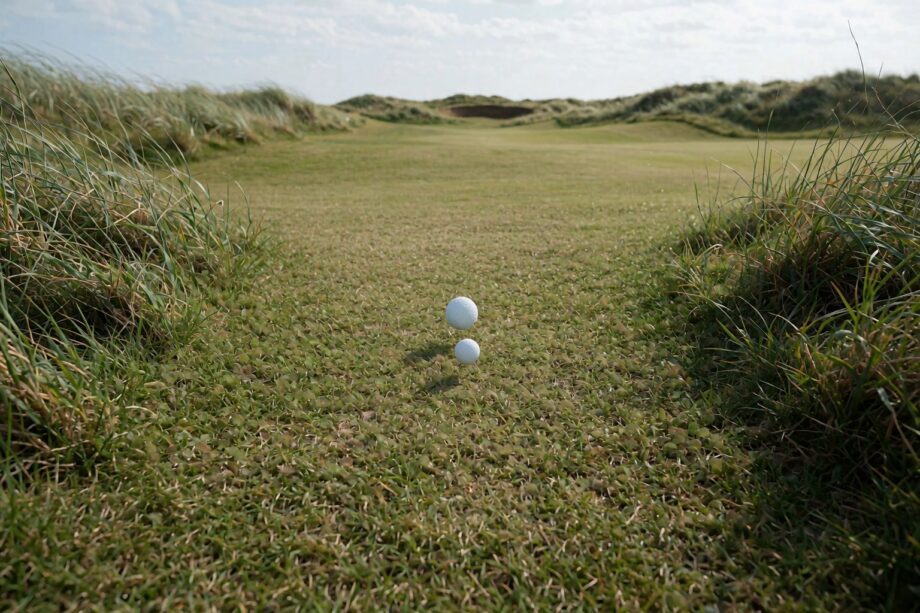
The plate we made for this subject shows a ball low over the turf, drawn in our own digital engraving style. Let us go through the history properly.
What was the first golf ball made of?
For a long time the standard golf ball was the featherie. It was a leather pouch, stitched, stuffed with boiled feathers, then sealed and painted. Tradition says a top hat’s worth of feathers went into a single ball, and that is the sort of detail that survives because it is so vivid. Whether every maker measured it that way, I would not swear to.
What is well recorded is that the featherie was laborious to make and easy to spoil. A wet round could split the leather, and a good ball flew well but was costly for the amount of use it got. Golf in that period was a game for people who could afford to lose balls, or who had a maker close by.
Its surface, as far as anyone thought about it, was just a painted leather skin. Nobody was designing it to change the flight. It was smooth because that was how a stitched pouch turned out.
The gutty, and the discovery of the nick
Around 1848 a new kind of ball appeared, made from gutta-percha, a hard, rubbery material taken from the sap of trees in South-East Asia. The Reverend Robert Adams Paterson is the name usually attached to its arrival in Scotland. You will also hear a popular tale that the material first reached golfers as packing around something shipped from overseas. I have not found that supported well enough to repeat as fact, so treat it as a story.
The appeal of the gutty was practical. It was cheaper than the featherie, it was tougher in the wet, and a damaged one could be softened and moulded again. The traditional makers were not always pleased. There is an account of the great featherie maker Allan Robertson being wary of the new ball and reluctant to see it take over, which is easy to believe, since it threatened his trade. The details of that story vary with the teller, so hold it lightly.
Now the part that matters for this article. A new gutty was smooth, and a smooth ball, by many accounts, did not fly well. Players found that balls which had been played for a while, and picked up cuts and nicks along the way, flew better than the fresh ones. That observation is the heart of the whole story, and it is a good one, because it runs against instinct. We tend to think a perfect surface is the best surface. Here the marks did the work.
Makers responded by giving the ball its marks on purpose. They took a hammer with a sharp edge and struck the surface all over, so that a new ball left the workshop already scarred. After that came moulds that pressed a pattern into the ball as it was formed, which was quicker and more even than hammering by hand.
What is a bramble golf ball?
The moulded patterns of the later nineteenth century took various forms, and one has a lovely name. The bramble pattern was a surface of small raised bumps, and the resemblance to a blackberry is where the word comes from. If you have picked blackberries from a hedge, you know the look: a cluster of small, close-set rounds.
Bramble balls were the gutty at its most developed. The idea had moved from accidental damage, to hammered damage, to a designed texture. Golfers had worked out that a roughened surface helped the ball, even if the explanation was not yet clear to them.
The explanation, as we understand it now, goes like this. Air flowing past a smooth ball tends to peel away from the surface early, leaving a wide, messy wake behind it. That wake drags at the ball. A rough surface stirs the thin layer of air right next to the ball so that it clings on for longer before separating. The wake behind is narrower, and the drag is lower. Add backspin, and the pattern of airflow above and below the ball produces lift too. This is why a well-struck ball can seem to climb and hang in the air rather than simply being thrown.
That last point is worth pausing on. The nineteenth-century golfer did not have this vocabulary. They had a ball that behaved better when it was marked, and an eye for what worked. The physics came afterwards to explain what the craftsmen had already found by hand.
Why do golf balls have dimples?
Around the turn of the twentieth century the golf ball changed again. Coburn Haskell, an American, worked with Bertram Work of the B.F. Goodrich company on a ball made of rubber thread wound under tension around a core and covered in gutta-percha. It was patented in 1899. It travelled further and felt livelier than the solid gutty, and it did not take long for serious players to notice. Sandy Herd won the Open Championship in 1902 using a Haskell, which is often cited as a sign that the new ball had arrived.
The early wound balls carried surface patterns of their own, including bramble-style markings. So the question of the surface did not go away with the change of construction. If anything it became more interesting, because now the ball underneath was livelier and the covering mattered all the more.
In 1905 a British engineer, William Taylor, patented a different idea: instead of raised bumps, a pattern of small dents. That is the dimple. It looks like a modest change, bumps turned inside out, but it is the shape that golf came to settle on. Dimpled covers spread through the game over the following years, and the raised bramble faded from use. Modern balls commonly carry somewhere between three hundred and five hundred dimples, and the exact layout is something manufacturers still work at.
I want to be careful here not to make the tidy claim that Taylor alone invented the whole business. The truth is a chain: featherie, gutty, the noticing of nicks, hammered marks, moulded bramble, the wound ball, and the dimple patent. Each link depended on the one before, and each came from people watching what a ball actually did.
Why this belongs on a shirt
What draws us to this piece of golf history is how human it is. Nobody in a laboratory decided that a golf ball needed a textured surface. A golfer picked up a battered ball, played it, and noticed it was better than the new one. Then a maker took a hammer to a smooth one and thought, why not do that on purpose?
The game still turns on small matters of surface: turf, sand, the grain of a putting green, the dents on the ball. The ball low over the ground on our plate is our nod to that early period, when a hard, plain-looking gutty was being coaxed into flight by a few cuts. It is drawn in an engraving style, because that is how we like to picture the old game, though the artwork is ours and digital, and it does not pretend to be a survivor from the nineteenth century.
If the story of the scarred ball appeals to you as it does to us, the plate is waiting on the site, printed to order on shirts, sweatshirts and hoodies. You can find it just below.
See it in the collection: The Low Flight design