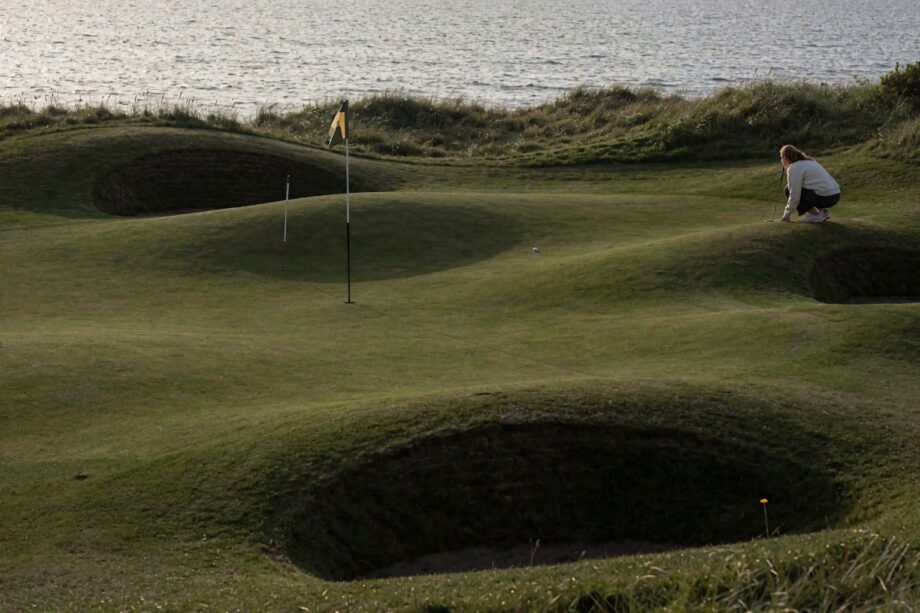
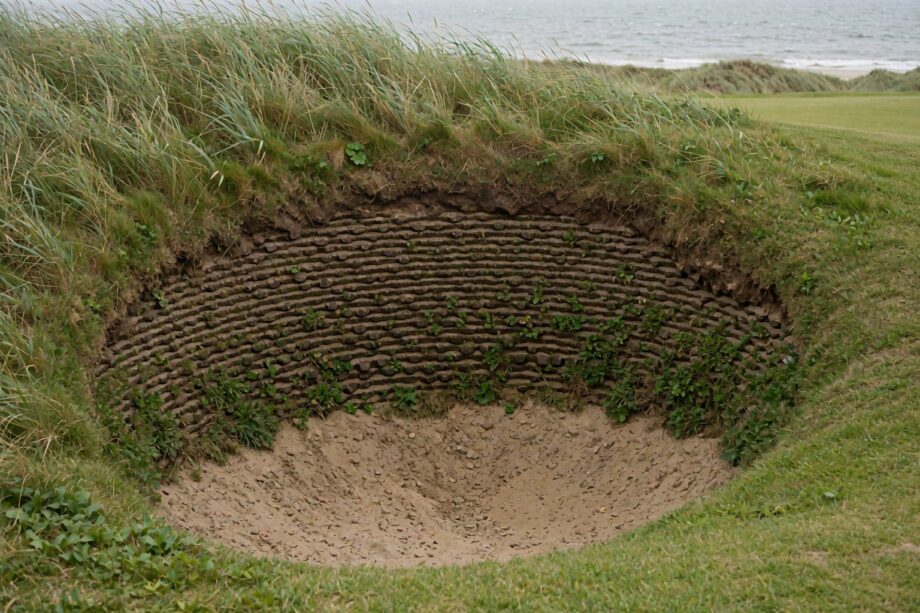
Links bunkers are small and deep because they began as hollows scraped out by sheep sheltering from the wind and scoured deeper by wind-driven sand, leaving a nick too tight and steep to escape with a flat swing. Many are faced with turf, built up in stacked, staggered layers called revetting, because a steep sand face on an exposed coast collapses without something to hold it.
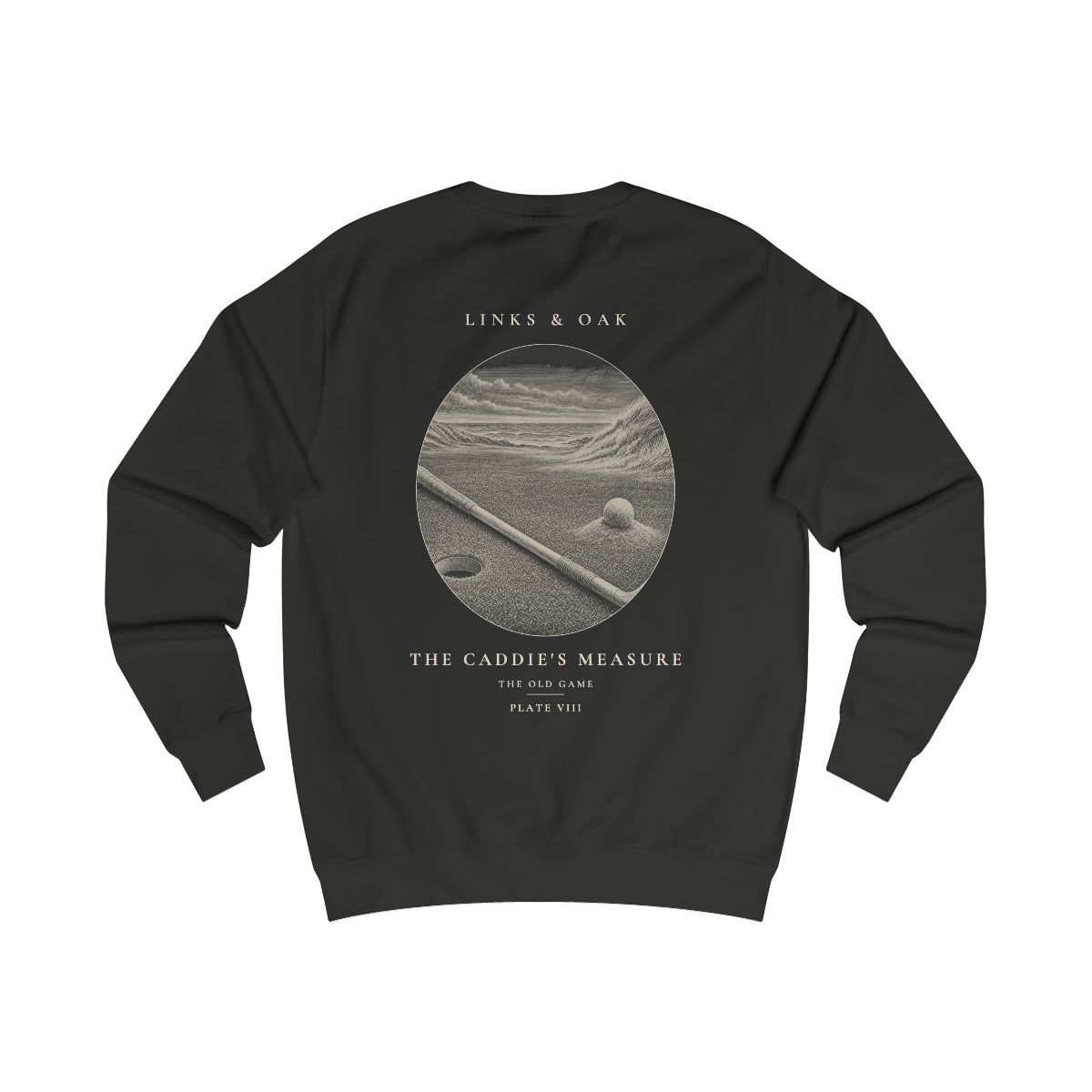
We love this feature more than most, and it is the scene on our plate “Between Dune and Sea”, a digital engraving-style artwork of ours, not an antique and not a picture of any real course. The thing it shows is real, though, and its history is older and stranger than the neat sand-and-grass picture suggests. Here is that history, with the guesses marked as guesses.
Land the sea left behind
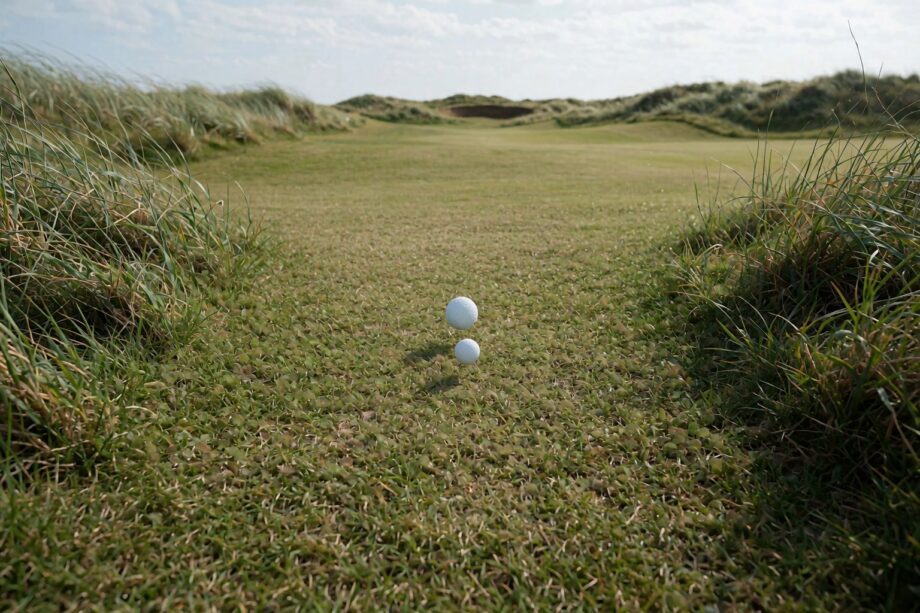
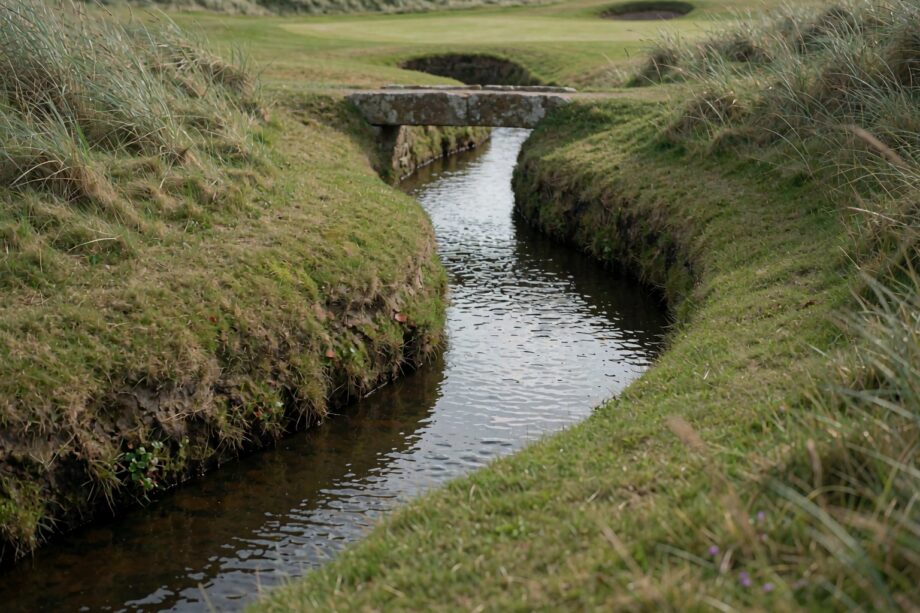
Golf’s oldest homes are links. The word comes from the Old English hlinc, a ridge or rising ground, and it came to mean the sandy, undulating strip between the beach and the farmland behind it. This was poor land for crops. Thin, sandy soil, salt wind, and grass fine enough that sheep and rabbits could keep it short without any help from us. Farmers did not want it. Early golfers, playing over common ground, were glad to have it.
Nobody sat down and designed the first bunkers. The best-supported explanation is the least glamorous one. Sheep sheltering from the wind scraped hollows into the side of a dune or a bank. Rabbits burrowed. Once the grass cover was broken, the wind got in and scoured the sand out further, and the hollow deepened. Golfers found the hollows and played round them, into them and out of them, because they were simply there. In that sense the earliest bunkers were found, not built. That is worth saying plainly, because the tidy idea of a course architect placing a hazard on a drawing belongs to a much later age.
Even the word has a modest background. Bunker is a Scots word, and its early senses were a chest, a box or a bench. It later turned up as a place to store coal. The golfing meaning came along afterwards, and the exact route from one to the other is not something we can pin to a single moment, so we will not pretend to.
What we can say is that on links land a bunker is a piece of the landscape first and a hazard second. It sits where the wind and the sand wanted it to sit. That is part of why the old ones feel so at home, and why so many newer ones, however handsome, feel like they were put there by somebody.
Why are links bunkers small and deep?
A pot bunker is small across and steep in the face. If you have played one, you know the feeling of standing in a space the size of a generous rug with a wall in front of you. Why that shape?
The likeliest reason follows from where they came from. A hollow scraped out by sheep or scoured by wind is naturally small. It is a nick in a dune, not a crater. And a small, deep hollow is one that a golfer cannot simply pick the ball out of with a long, flat swing. The ball sits low, the face is high, and there is very little room to take a run at it.
There is a practical side as well, and here we are reasoning rather than quoting a source, so weigh it accordingly. On a windy coast, a wide, shallow patch of exposed sand is a problem. The wind lifts it and moves it. A narrow bunker with a steep face gives the wind much less to work on and holds the sand in place better. A greenkeeper looking after links turf year after year would have found that out quickly. Small and deep is not only harder to escape from, it is easier to keep.
The effect on play is what people remember. On a links, where the ground is firm and the ball runs, a bunker sitting just short of a green does more than punish a bad shot. It changes what a good shot looks like. You cannot bounce the ball in past it. You have to decide whether to fly it over, and the wind, which is always in the conversation, has its say. A pot bunker asks a question of your nerve as much as your swing.
And sometimes the honest answer is that you cannot get at the green from where you are. Playing out sideways, or even backwards, is a perfectly respectable decision from the bottom of a deep pot bunker. Many a round has been saved by taking the one stroke that does not go towards the flag. That, in its way, is the oldest lesson in the game: the shot you play to get out of trouble is often more important than the one you play into it.
How is a revetted turf bunker face built?
The feature that gives our plate its character is the face of the bunker, built up in layers rather than left as a bare slope. This is called revetting, and the traditional form on links land is a wall of stacked turf.
The idea is simple to describe and slow to do well. Turf is cut into blocks, a bit like thick bricks, from ground that carries the right kind of grass. The blocks are then laid in courses, one on top of the next, staggered so the joints do not line up, the way a bricklayer would stagger a wall. Built well, the layers knit together, the grass roots into the soil below, and the wall holds a near-vertical face that plain sand and loose earth never could.
Why go to that trouble? Because a steep face on a windy coast wants to fall in. Left alone, a raw sandy bank slumps, blows out and wears away under feet and clubs and weather. The turf wall does two jobs at once. It keeps the bunker deep and its shape crisp, and it keeps the surrounding ground from collapsing into it. Look at a well-kept revetted bunker and you will see the courses running along the face like the pages of a closed book.
It is skilled work, and it does not last forever. Turf walls take knocks from balls, weather and the occasional frustrated club, and they need rebuilding from time to time. The people who do it are craftspeople in a real sense. They read the turf, judge how it will settle, and rebuild a face so that it looks like it has always been there. We can tell you that the layered look is the traditional one on links courses, and that it is still practised today. We would rather not put a number on how often a wall is rebuilt, because it varies with the site, the weather and the wear it gets.
One more point in favour of the method: the materials come from the land itself. Turf, sand and soil are all part of the same coastal ground the bunker sits in. A revetted face does not look imposed on the landscape because, in a real sense, it is made from it.
A hazard that changed its meaning
For a long time the bunker was simply something to avoid, and the way out of it was a matter of grim persistence with a short, heavy iron. The club that changed that, in popular memory at least, is the sand wedge. Gene Sarazen is the name most closely tied to it. He developed a wedge with a broad flange along the sole that made it bounce through the sand instead of digging in, and he won the 1932 Open Championship at Prince’s in Kent with it in his bag. Whether he was the first to think of such a club is argued over, but he is credited with bringing it to the wider game, and that is as far as we will go.
The rules have moved too. In 2019 the Rules of Golf were revised so that touching the sand with your club, or removing loose impediments in a bunker, no longer draws the automatic penalty it once did. Before that, a stray touch of the sand in a backswing could cost you a stroke. The bunker still asks something of you. It just asks it a little more fairly.
Look at what has not changed, though. On a proper links, a pot bunker still does what the sheep-scraped hollow once did. It sits in the way, small and unforgiving, and it makes you think. Nobody has improved on that, and nobody has tried very hard, because it is already right.
That is the scene we wanted to capture: the dune behind, the sea beyond, and the stepped turf wall in the middle, small and deep and quietly menacing. “Between Dune and Sea” is our digital engraving-style plate of exactly that, drawn for people who love the old game and know why a small hole in the sand can matter so much. It shows an imagined place, not a real named course, and we would like it to feel like the kind of corner you have stood in and never forgotten. If the pot bunker has ever ruined your afternoon and made you love the game a little more for it, that plate is for you.
See it in the collection: The Between Dune and Sea design