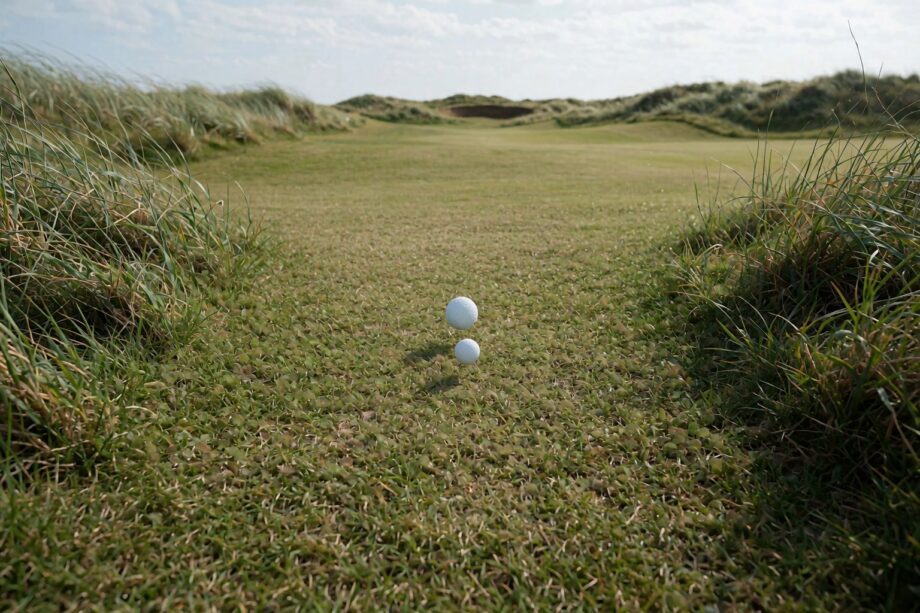

The earliest written rules of golf, the thirteen articles drawn up in 1744 for the Gentlemen Golfers of Leith, say a player must tee the ball within a club’s length of the hole just finished. There was no tee box, no marker, no mown rectangle: the next hole began wherever the ball lay, measured out with the club in hand.
St Andrews adopted the same rule in 1754, so this was not one club’s habit but the shared understanding of the game at its two earliest, most important homes.
What was golf’s early ‘club’s length’ rule?
The earliest written rules of golf that survive are the thirteen articles drawn up in 1744 for the Gentlemen Golfers of Leith, later known as the Honourable Company of Edinburgh Golfers. They were written for a competition over the links at Leith, played for a silver club put up by the city of Edinburgh. The first article says you must tee your ball within a club’s length of the hole.
That is worth reading twice. There was no separate teeing ground. The hole you had just finished was the starting point for the next, and you measured your distance with the club in your hand.
The St Andrews golfers wrote down their own set of rules in 1754, and they followed the Leith articles very closely, this one included. So the club’s length rule was not one town’s habit. It was the shared understanding of the game at its two most important early homes.
It also tells you something about how those courses were laid out. On a links, the ground beside the hole was often the ground you were about to play from. The holes were cut into the turf, the next tee was a short step away, and the whole round flowed in a way that is quite different from the walk to a distant tee that we take for granted now. When you look at how St Andrews changed in 1764, when the first four holes were reduced to two and the round went from twenty-two holes to eighteen, you can see a course being reshaped around that steady, connected rhythm.
What did a tee actually look like at that point? By the accounts we have, players built one from a small pinch of damp sand or earth taken from near the hole, then set the ball on top. The wooden peg is a later idea. Sand made the whole business a little messy, and that mess is part of why the rule and the ground around each hole mattered so much.
The rule did not last unchanged. Over the following century golf grew busier, and the practical trouble of players teeing up on top of the hole they had just finished was obvious. Later codes replaced the club’s length with a defined teeing ground, and that idea has stayed with us ever since. I have left out an exact date for the change, because the sources I trust describe it as gradual and vary between clubs, and it would be wrong to pin a neat year on it.
Where does the word ‘caddie’ come from?
Now put a second person into that scene. Someone is standing a step behind the player with the clubs.
The word caddie comes from the French cadet, a younger son or junior, and dictionaries trace it into Scots as a name for a person who ran errands and did odd jobs about a town such as Edinburgh. Golf took the word and made it its own. You will often read that Mary, Queen of Scots had cadets carrying her clubs at St Andrews in the sixteenth century. It is a well loved story, and it is repeated everywhere, but I would treat it as a story rather than a settled fact, because it does not rest on a firm contemporary record.
What we can say plainly is this. By the eighteenth and nineteenth centuries, caddies were a normal part of the game on the Scottish links. Players carried only a handful of clubs in those days, and the clubs were fragile, hand made and expensive to replace. Before the golf bag became common, a caddie would often carry the clubs together under an arm. It was a job that needed care as well as a strong back.
It was also a job that needed judgement, and that is the part I find most interesting. A good caddie did not just carry. He knew the course as a working person knows the place they spend every day: the run of the ground, the bunkers that could not be seen from the tee, the way the wind came in off the water, the pace of a green in a dry spell. When the rule said you teed within a club’s length of the hole, there was a caddie beside you who had already watched the last player make the same journey a hundred times and could say where the ball would run.
The working side of the trade is less romantic than the pictures suggest. Caddies were typically local men and boys who took the work alongside whatever else they did, and they were paid by the round or by the day. Some became so skilled at playing that they moved into the game itself. That route, from carrying clubs to making them, teaching the game and eventually playing in the great competitions, is one of the well recorded threads in the early history of professional golf.
Can a caddie give a golfer advice?
A caddie’s advice was the point of hiring one. Which club, which line, how far to carry the bunker, whether to play safe. That knowledge was worth having, and it is one reason golf’s rules have spent so long deciding exactly who a player may ask for help and who they may not.
The modern rules of golf still recognise the caddie as the one person a player may take advice from during a round, besides a partner in a team competition. That principle is not a modern invention. It grew out of a practice that was already well established on the early links.
You can see how far the caddie’s place in the game lasted in a famous American moment. In 1913, at the US Open at The Country Club in Brookline, Massachusetts, a young amateur named Francis Ouimet beat the leading British professionals Harry Vardon and Ted Ray in a playoff. His caddie was a ten year old boy called Eddie Lowery. The story is well documented, and it is a reminder that the partnership between a player and the person carrying the bag could still decide the biggest days in the sport well after the rule of the club’s length had been forgotten.
Two things are worth holding on to here. First, the caddie was a skilled, working presence on the course from the very early days, not a decoration. Second, the game that caddie served had rules that look strange to us today and made perfect sense in their own setting. Teeing within a club’s length of the hole is a good example. It is only odd if you forget that the course itself, and the way people moved around it, was different.
The scene on our plate
This is the history behind our plate The Caddie’s Measure. The scene is the one this article has described: a player, a caddie a step behind, and the simple business of measuring out a club’s length from the hole before the next stroke.
One thing to be clear about. Our plates are digital artwork, made in the style of an old engraving. They are not antique prints, they are not hand engraved, and they are not historical originals. Nor does any plate show a real, named course. We draw on the real history of the game, and we try to tell it straight, including where a popular story is only a story, but the artwork is our own.
If you love the old game and the working people who made it what it was, the plate is there to be worn on a T-shirt, sweatshirt or hoodie, printed to order in the UK or the USA. It is a small nod to the caddie who walked one step behind, knew the ground better than the player did, and rarely got the credit.
See it in the collection: The The Caddie’s Measure design